Playing the same lottery numbers for 10, 20, 30 or 50 years: the cumulative jackpot probability step by step, and what loyalty to a line really changes.
Playing the same lottery numbers in every draw for 30 years gives you a probability of having hit the jackpot at least once of about 1 in 44,820 in EuroMillions (0.0022%) and about 1 in 62,437 in Powerball (0.0016%). That is higher than the probability of a single draw, but it is still tiny. And it changes nothing about the next draw: it keeps its starting probability, however many years you have already played.
The news has brought the subject back. According to The Independent (October 9, 2026), the amateur club Longlevens AFC, in Gloucester, won £1 million on the UK Lotto after 32 years of playing the same numbers. It is a great story. It proves nothing about the method: you never read about the loyal players who won nothing.
Cumulative probability: the calculation step by step
A single draw has a probability p of giving your line the jackpot. If you play n draws, the probability of having won at least once is:
1 − (1 − p)^n
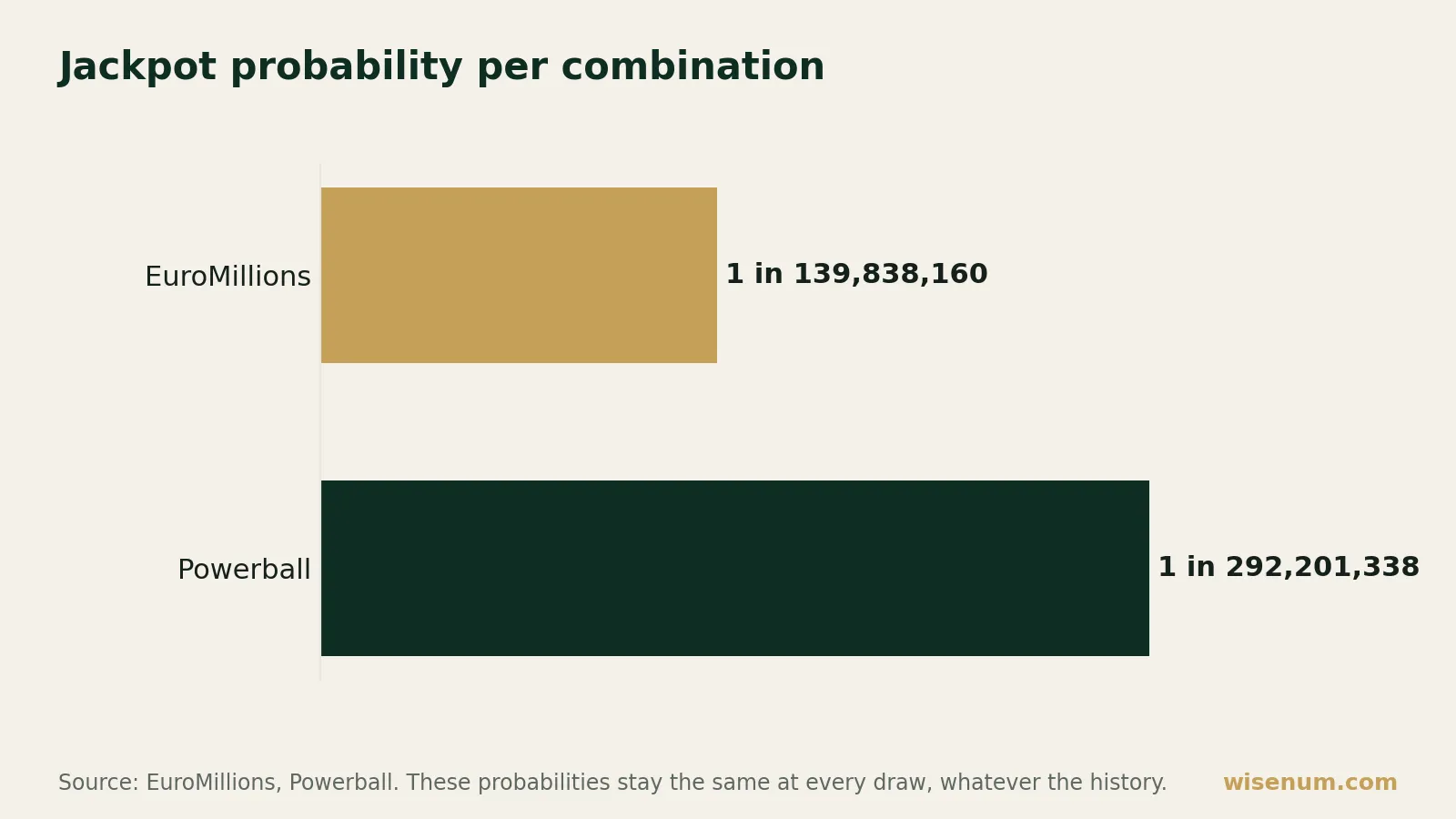
For a p this small, the result is very close to n × p. Take EuroMillions: p = 1 in 139,838,160 (Lottery.co.uk), with two draws a week, on Tuesday and Friday (National Lottery). That makes 2 × 52 = 104 draws a year (we round to 52 weeks a year).
For 30 years:
- n = 104 × 30 = 3,120 draws;
- 3,120 ÷ 139,838,160 = about 1 in 44,820.
EuroMillions and Powerball: 10, 20, 30 or 50 years of play
Powerball has a jackpot probability of 1 in 292,201,338 (Powerball), with three draws a week: Monday, Wednesday and Saturday (Powerball). That gives 3 × 52 = 156 draws a year (same rounding).
Here are the results of the calculation, rounded, for one line played in every draw.
EuroMillions (104 draws a year):
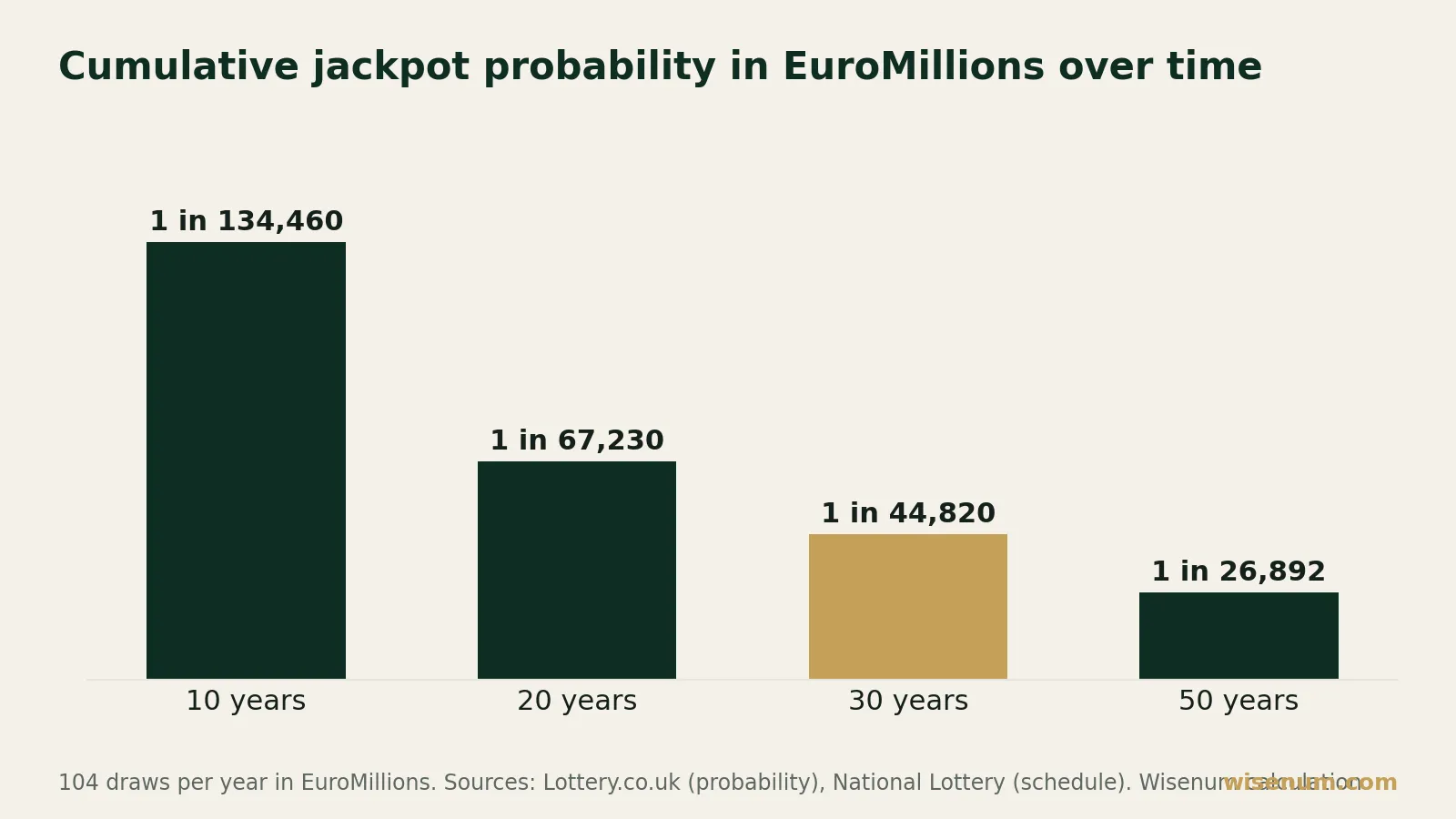
- 10 years, 1,040 draws: about 1 in 134,460 (0.00074%);
- 20 years, 2,080 draws: about 1 in 67,230 (0.00149%);
- 30 years, 3,120 draws: about 1 in 44,820 (0.00223%);
- 50 years, 5,200 draws: about 1 in 26,892 (0.00372%).
Powerball (156 draws a year):
- 10 years, 1,560 draws: about 1 in 187,309 (0.00053%);
- 20 years, 3,120 draws: about 1 in 93,655 (0.00107%);
- 30 years, 4,680 draws: about 1 in 62,437 (0.00160%);
- 50 years, 7,800 draws: about 1 in 37,462 (0.00267%).
These values assume regular play, with no breaks. You can redo each line yourself: divide the number of draws by the number of possible combinations (139,838,160 or 292,201,338), then invert the result.
A concrete picture
Imagine an urn holding 139,838,160 balls, only one of them a winner. Over 30 years of EuroMillions, you get 3,120 draws, so 3,120 balls out of the 139,838,160. Your share of the urn is 3,120 in 139,838,160, or 1 in 44,820: it is like picking the right ball on the first try from an urn of 44,820.
And to reach 50%? You need about 0.693 × 139,838,160, or nearly 96.9 million draws. At 104 draws a year, that is about 932,000 years. In Powerball, with 0.693 × 292,201,338 ≈ 202.5 million draws at 156 a year, you get about 1.3 million years. A lifetime of play comes nowhere near it.
What it really changes: the independence of draws
The cumulative probability rises over the years, but only because you add draws. It does not change the probability of any given draw.
Each draw is independent of the one before. A line played for 30 years has, in the next draw, exactly the same probability as a line picked this morning: 1 in 139,838,160 in EuroMillions, 1 in 292,201,338 in Powerball. There are no "due" numbers just because they have not come up in a long time. This illusion has a name, the gambler's fallacy, which we cover in Gambler's Fallacy and Due Numbers: What Research Really Shows.
In other words, staying loyal to a line makes it neither more nor less likely. The probabilities of each prize tier are on the EuroMillions odds page and the Powerball odds page.
Your favorite line stays popular for 30 years
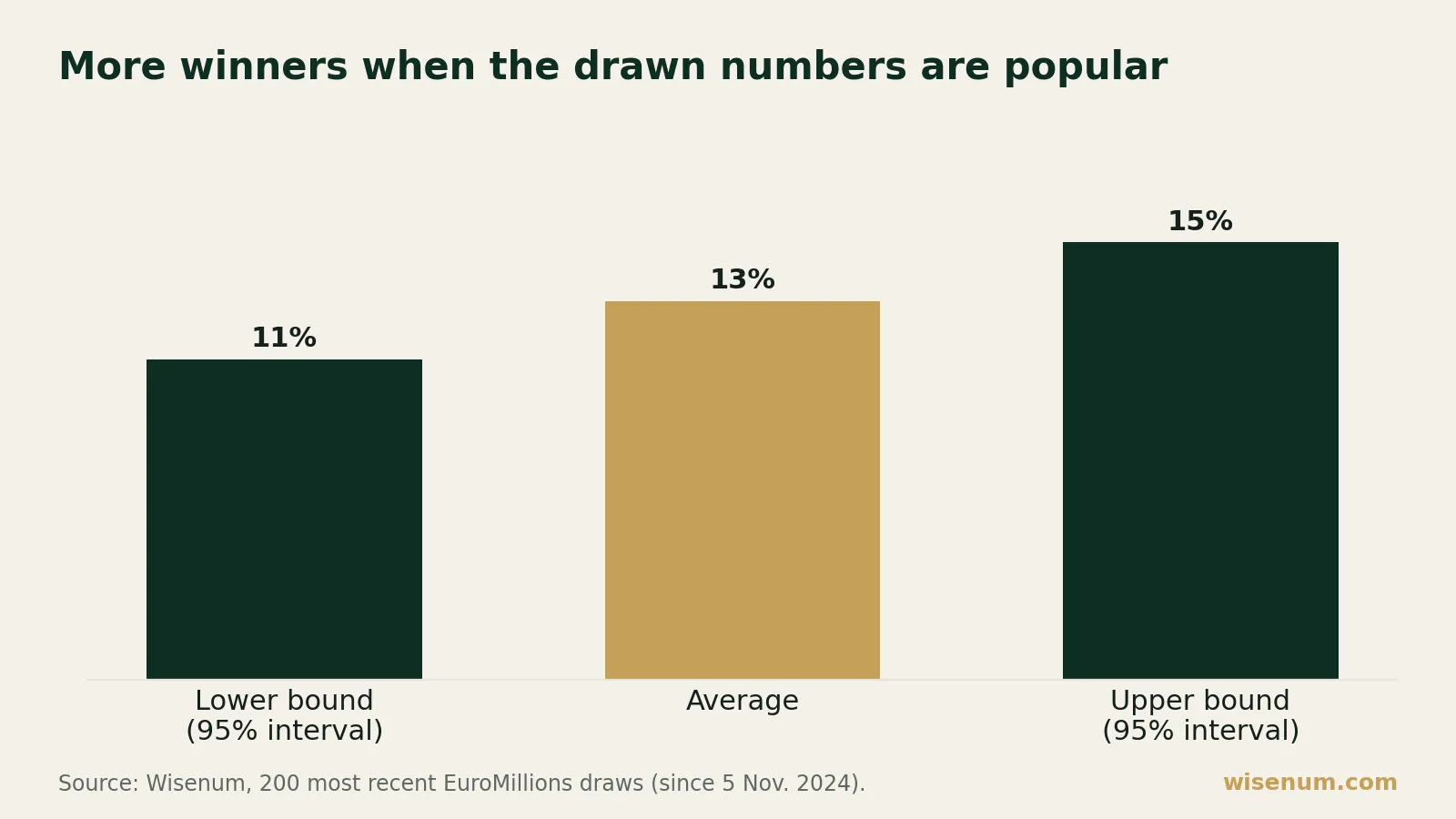
Loyalty does change one thing, though: how a win is shared. A popular line, meaning one played by many people, is popular in every draw. If you keep it for 3,120 draws, it is as popular in the first as in the last. If it wins, the risk of sharing the jackpot stays of the same order from one draw to the next.
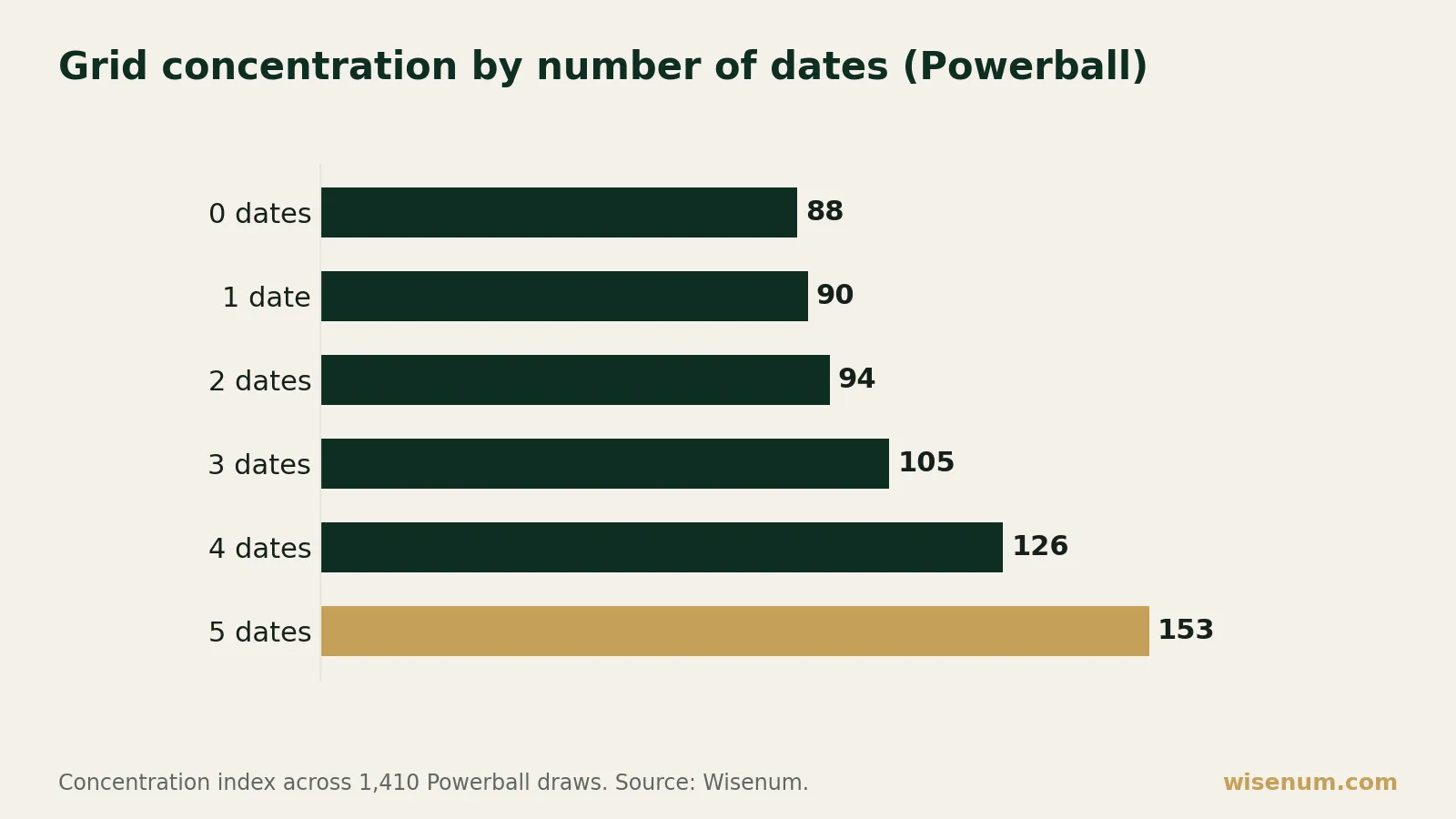
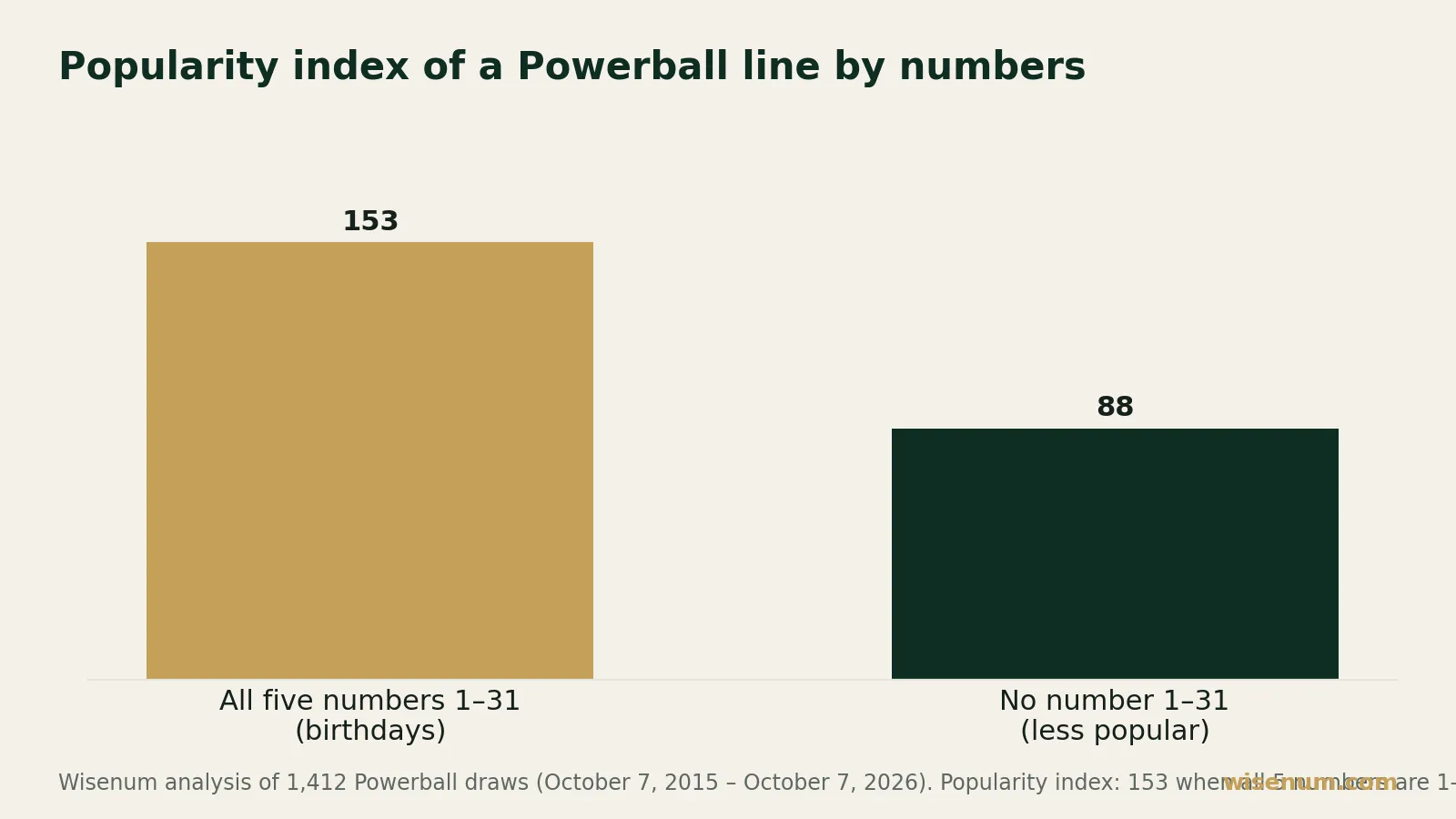
Birthdays are the classic example: they limit choices to the numbers 1 to 31. Wisenum's Powerball data covers 1,412 draws (from October 7, 2015 to October 7, 2026), grouped by how many main numbers fall between 1 and 31. The popularity index is 153 when all five numbers are in that range, against 88 when none are. The ratio is 1.73 (95% interval: 1.64 to 1.83). These are estimates for the main numbers, not for the red Powerball. The method is detailed on the Powerball methodology page.
This does not change the probability of winning. It changes the risk of sharing a win: a line made of dates is more often played by others. To understand why players converge on the same numbers, read Lottery Number Patterns: Why Players Choose the Same Numbers.
The real lever: keep your numbers and complete them
Should you give up your lucky numbers? No. Wisenum never asks you to change them. The idea is to keep your favorite numbers and complete them with others, to get a line that fewer people play. The probability of each draw stays the same, but the risk of sharing a possible win goes down.
This is the only real lever, because it applies to every draw, and you may play hundreds or thousands of draws with the same line. If you are torn between choosing and letting chance decide, Quick Pick vs Choose Your Own Numbers: Same Odds, Different Sharing compares the two.
The takeaway
- Over 30 years, the probability of having hit the jackpot with the same line is about 1 in 44,820 in EuroMillions and 1 in 62,437 in Powerball. It stays very low, even after 50 years.
- Patience changes nothing: each draw is independent, and an old line is no more likely than a new one.
- Loyalty to a line only matters for sharing: a popular line stays popular in every draw. Keeping your favorite numbers and completing them for a less-played line reduces the risk of sharing a win.
Playing the next draw? See whether your line looks like the most common picks: Analyze a line
Play for fun, and only spend what you can afford to lose. Responsible gambling support: in the US, call 1-800-GAMBLER (ncpgambling.org); in the UK, visit BeGambleAware.
Frequently asked questions
What is the probability of winning the jackpot by playing the same line for 30 years?
About 1 in 44,820 in EuroMillions and 1 in 62,437 in Powerball. These cumulative probabilities stay very low, even over several decades. For comparison, it is like picking the one winning ball on the first try from an urn of 44,820.
Do my numbers become more likely if they haven't come up in a long time?
No. Each draw is independent of the one before. A line played for 30 years has exactly the same probability as a line picked this morning: 1 in 139,838,160 in EuroMillions, 1 in 292,201,338 in Powerball. The idea that "due" numbers become more likely is called the gambler's fallacy, and it has no basis in mathematics.
So what really changes when you play for 30 years?
What changes is not the probability of winning, but how a win is shared. A popular line (for example, birthday dates) stays popular in every draw. If you keep the same line for 30 years, it does not become more shared: it is as popular in the first draw as in the 3,120th, so the risk of sharing a win stays the same each time.
Should I give up my lucky numbers?
No. Wisenum never asks you to change them. The idea is to keep your favorite numbers and complete them with others to get a line that fewer people play. The probability of each draw stays the same, but the risk of sharing a possible win goes down.
How long would you have to play to reach a 50% cumulative probability?
About 932,000 years in EuroMillions (104 draws a year) and 1.3 million years in Powerball (156 draws a year). A lifetime of play comes nowhere near it.
Every valid combination has the same probability of being drawn. Wisenum does not predict winning numbers.
Sources
- Powerball Prize Chart and Odds
- National Lottery UK – EuroMillions About
- Lottery.co.uk – EuroMillions Odds
- Powerball – Home and Game Rules
- The Independent – Longlevens AFC £1m Lotto Win
- Wisenum Powerball popularity model, 2026
- Wikipedia – EuroMillions
- Wisenum – Erreur du joueur : numéros dus et indépendance