Why lottery players believe in due numbers. The psychology and mathematics behind the gambler's fallacy explained with real data.
In the EuroMillions draw, every combination has a probability of 1 in 139,838,160. It is worth exactly the same whether the combination came up recently or has never been drawn. Yet many players are convinced that a number absent for a long time is eventually "due". This reflex has a name, the gambler's fallacy, and researchers have been studying it for more than fifty years.
What is the gambler's fallacy?
The gambler's fallacy (also called the Monte Carlo fallacy) is the belief that an independent event which has happened less often than expected in earlier trials becomes more likely in later trials, or the reverse (definition and references on Wikipedia).
It works in both directions. Some players think a number that has been absent for a long time is "due". Others think a number that has just come up will not come up twice in a row. In both cases, the reasoning assumes the draw "remembers" what happened before. It does not.
What psychology says
Psychologists Amos Tversky and Daniel Kahneman described the representativeness heuristic in 1972, in "Subjective Probability: A Judgment of Representativeness" (Cognitive Psychology). It rests on a belief in a "law of small numbers": people expect even a short run of random results to resemble the process as a whole, with outcomes balancing out quickly.
In their 1974 article, "Judgment under Uncertainty: Heuristics and Biases" (Science), they illustrate this bias with roulette. After a long run of black, most people believe red is now "due" to restore the balance.
This belief resists information. According to the review published in Frontiers in Psychology ("The Gambler's Fallacy: A Basic Inhibitory Process?"), the study by Beach and Swensson (1967) showed that participants who had been warned about the fallacy and about the independence of events still based their choices on the length of the sequences they had observed.
The mathematics of independent draws
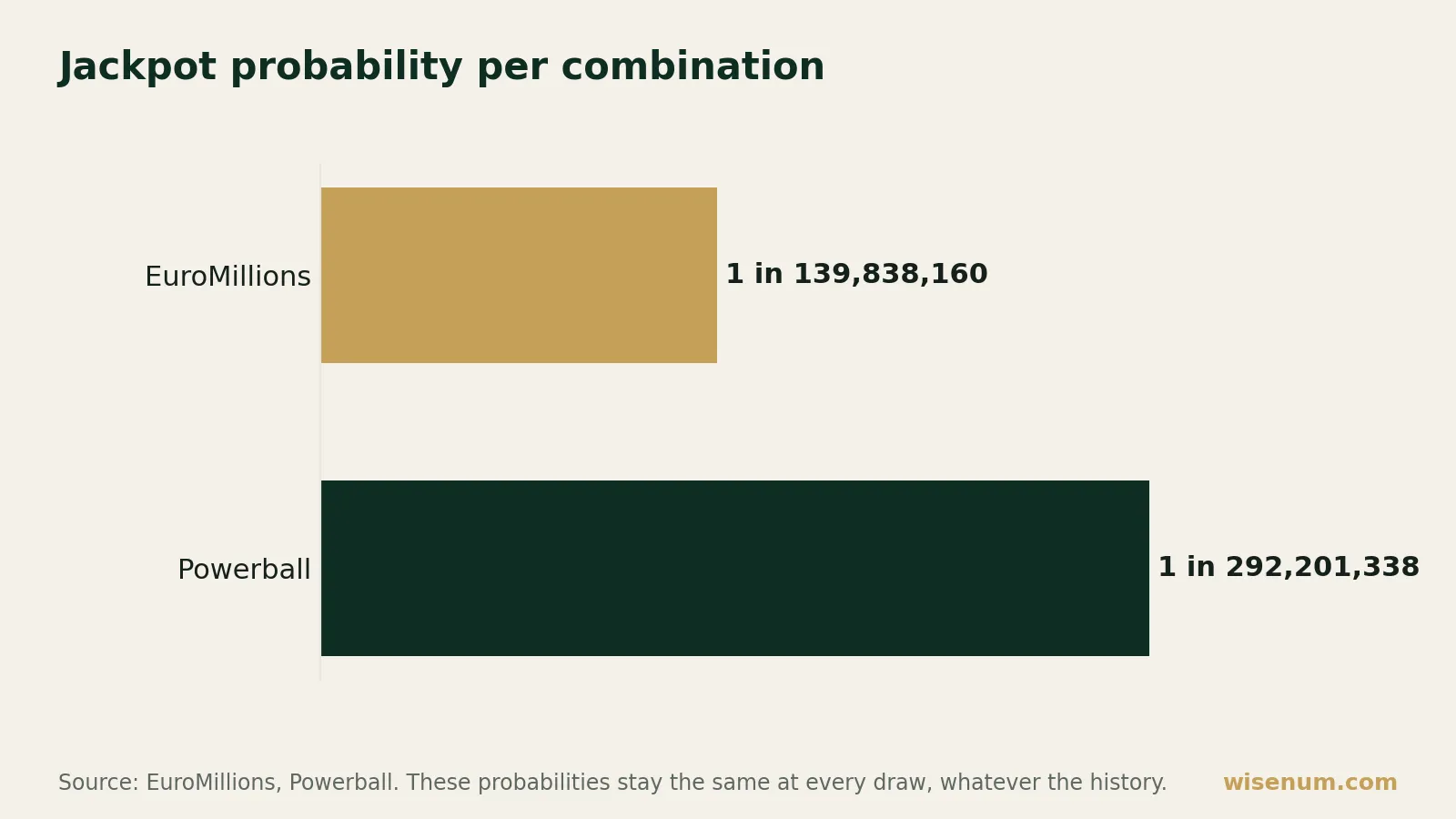
A lottery draw is an independent event: its probability does not depend on previous draws (Duke University, Department of Mathematics). The probabilities never change from one draw to the next. You will find the full calculation in our article on how EuroMillions odds are calculated.
- EuroMillions: 1 in 139,838,160 per combination;
- Powerball: 1 in 292,201,338 per combination.
To see why, start with a coin. The probability of getting five heads in a row is 0.5 × 0.5 × 0.5 × 0.5 × 0.5 = 1/32, or 3.125%. That is rare. But once the five heads have landed, the probability that the sixth toss comes up tails is still 0.5 (50%). The rarity of the past run does not carry over to the next toss.
Let's do the same calculation for a EuroMillions combination. Let p = 1/139,838,160.
- Probability that it does not come up in 100 draws: (1 − p)¹⁰⁰, which is roughly 1 − 100 × p = 1 − 0.0000007 ≈ 99.99993%.
- Probability that it does not come up in 100 draws, then comes up on the 101st: (1 − p)¹⁰⁰ × p.
- Probability that it comes up on the 101st draw, given that it has not come up in the first 100: (1 − p)¹⁰⁰ × p ÷ (1 − p)¹⁰⁰ = p.
The term (1 − p)¹⁰⁰ cancels out. One hundred draws without the combination, or a thousand, or none: the probability at the next draw stays 1 in 139,838,160. A "debt" owed by chance would push this result above p. The calculation shows no such debt exists.
To get a sense of scale, 139,838,160 seconds is more than four years (139,838,160 ÷ 31,557,600 seconds per year ≈ 4.4 years). Hitting a given combination is like guessing, at random, one precise second out of those 4.4 years.
For comparison, there are cases where probability really does change: drawing cards from a deck without putting them back. There, the cards already drawn do change what is left. A lottery draw, on the other hand, stays independent of the previous ones.
What real player data shows
The draw does not react to its past, but players do. The study by Clotfelter and Cook (1993), published in Management Science ("The 'Gambler's Fallacy' in Lottery Play"), covers the Maryland numbers game over 52 consecutive winning numbers. Bets on a number drop sharply right after it wins, then climb back gradually over several months. Players therefore avoid numbers that have just won.
More recent work points the same way. Dillon and Lybbert (2024), using administrative lottery data from Haiti and Denmark, find that on average players avoid numbers that have recently won ("The gambler's fallacy prevails in lottery play", Journal of Risk and Uncertainty).
These studies measure player behavior, not a property of the draw. They say nothing about any number being more or less likely to come up.
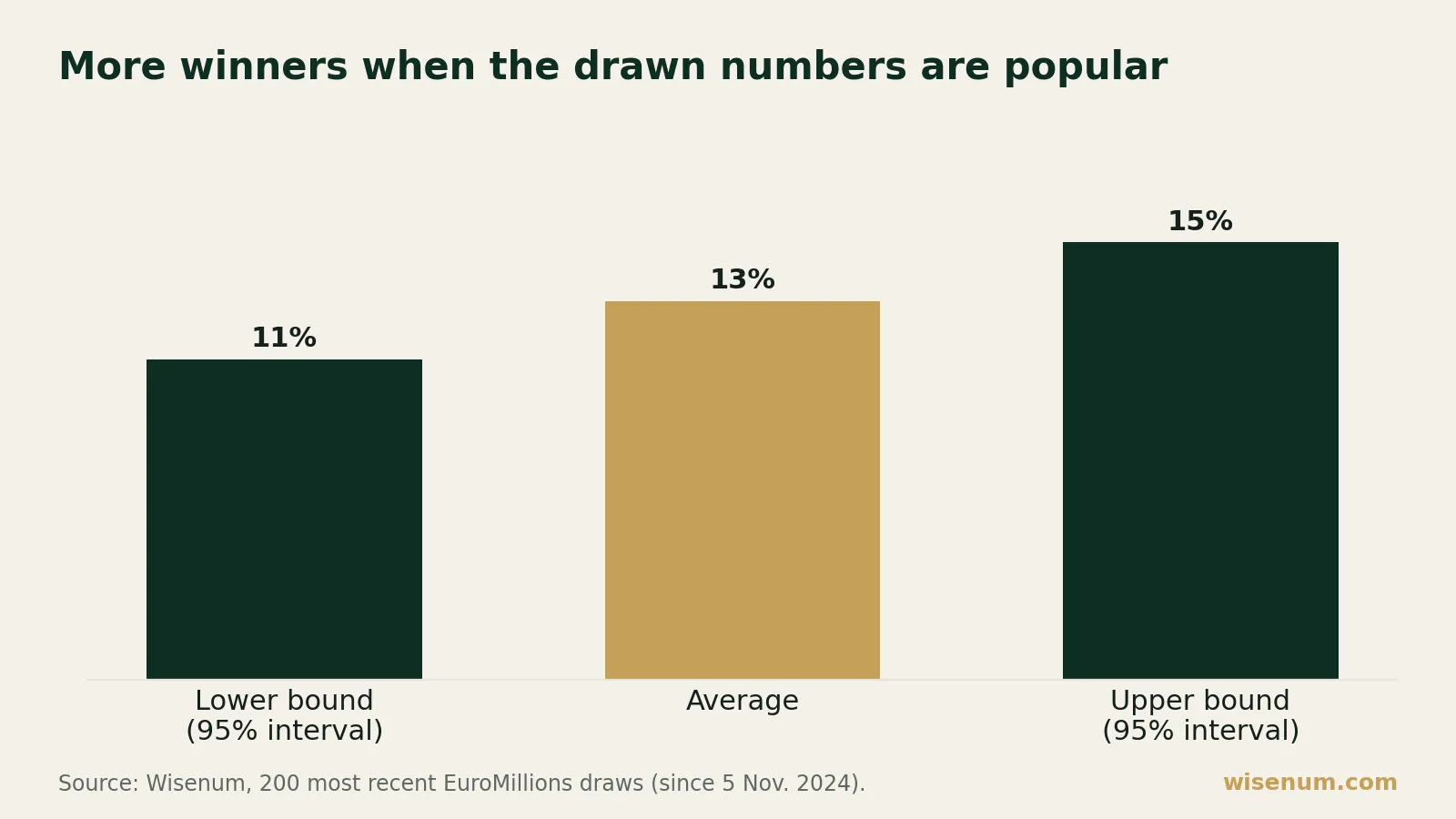
Wisenum, for its part, estimates how popular the lines played are, based on the number of winners per draw. According to the Wisenum model, validated on 694 EuroMillions draws (from February 4, 2020 to September 25, 2026), the popularity ratio over the last 200 draws, since November 5, 2024, is 1.128 (95% confidence interval: 1.108 to 1.149). For Powerball, over the last 200 draws since June 25, 2025, it is 1.264 (interval of 1.216 to 1.314). A ratio above 1 indicates that players do not pick their numbers at random: some combinations are played more often than others. For Powerball, the estimate covers the five main numbers, not the Powerball number.
These figures show that players' choices are not spread at random. On their own, they cannot isolate the cause: birth dates, personal numbers and the gambler's fallacy may all contribute. Real player preferences are documented separately.
Why does the fallacy persist?
Three elements stand out from the research:
- The intuition of balance. According to the representativeness heuristic, a short run "must" resemble the average. That expectation is wrong for independent events.
- Resistance to information. Knowing that draws are independent is not always enough. Participants in Beach and Swensson (1967) knew it and were still guided by the length of sequences.
- A possible brain mechanism. According to the Frontiers in Psychology review, neuroimaging studies suggest that sensitivity to the gambler's fallacy depends more on the prefrontal cortex (goal-directed executive processes) than on the areas that govern affective decisions.
This last point remains a lead for research, not a definitive explanation. Work on the exact causes of the fallacy continues.
The takeaway
There are no "due" numbers. A lottery draw keeps no memory: the probability of each combination stays the same, 1 in 139,838,160 for EuroMillions and 1 in 292,201,338 for Powerball, whatever the draw history. The calculation shows it: the probability of coming up at the next draw, given 100 draws without it, is exactly the same (p = 1/139,838,160 for EuroMillions).
What varies is player behavior, as measured by Clotfelter and Cook, then by Dillon and Lybbert. Studies of the gambler's fallacy describe a way of reasoning, not a way of reading the draws. Remembering that a number is neither "due" nor "hot" is the first way to keep a clear head in front of chance.
Playing the next draw? See where your line sits compared with the most common picks: Analyze a line.
Play for fun, and only spend what you can afford to lose. Responsible gambling support: in the US, call 1-800-GAMBLER (ncpgambling.org); in the UK, visit BeGambleAware.
Frequently asked questions
What is the gambler's fallacy?
The gambler's fallacy is the belief that an independent event which has happened less often than expected becomes more likely afterwards. For example, thinking that a number absent for a long time is eventually "due". It is a mistake: every draw is independent, and the probability stays exactly the same.
Why do players believe in due numbers?
According to psychology, people expect even short runs of random results to resemble the overall average, with outcomes balancing out quickly. This is the representativeness heuristic, described by Tversky and Kahneman. But a draw does not "remember" its past results.
Does the probability change after 100 draws without a hit?
No. The probability that a combination comes up at draw 101, given that it has not come up in the first 100, is exactly p = 1/139,838,160 in EuroMillions. The term (1 − p)¹⁰⁰ cancels out in the conditional calculation.
Do real players avoid numbers that have just come up?
On average, yes. The studies by Clotfelter and Cook (1993) and by Dillon and Lybbert (2024) show that players avoid numbers that have recently won. This behavior is consistent with the gambler's fallacy, but it changes nothing about the draw: the probability of each combination stays the same.
Every valid combination has the same probability of being drawn. Wisenum does not predict winning numbers.
Sources
- Gambler's Fallacy - Wikipedia
- Subjective Probability: A Judgment of Representativeness - Tversky & Kahneman (1972)
- Judgment under Uncertainty: Heuristics and Biases - Tversky & Kahneman (1974) - Science
- The Gambler's Fallacy: A Basic Inhibitory Process? - Frontiers in Psychology
- Gambler's Fallacy - Duke University Mathematics
- The 'Gambler's Fallacy' in Lottery Play - Clotfelter & Cook (1993) - Management Science
- The gambler's fallacy prevails in lottery play - Dillon & Lybbert (2024) - Journal of Risk and Uncertainty
- Wisenum EuroMillions Popularity Model (2026)