How to organize a lottery pool: a written agreement, fair shares, proof of tickets, and what Wisenum Pools adds for verified draws.
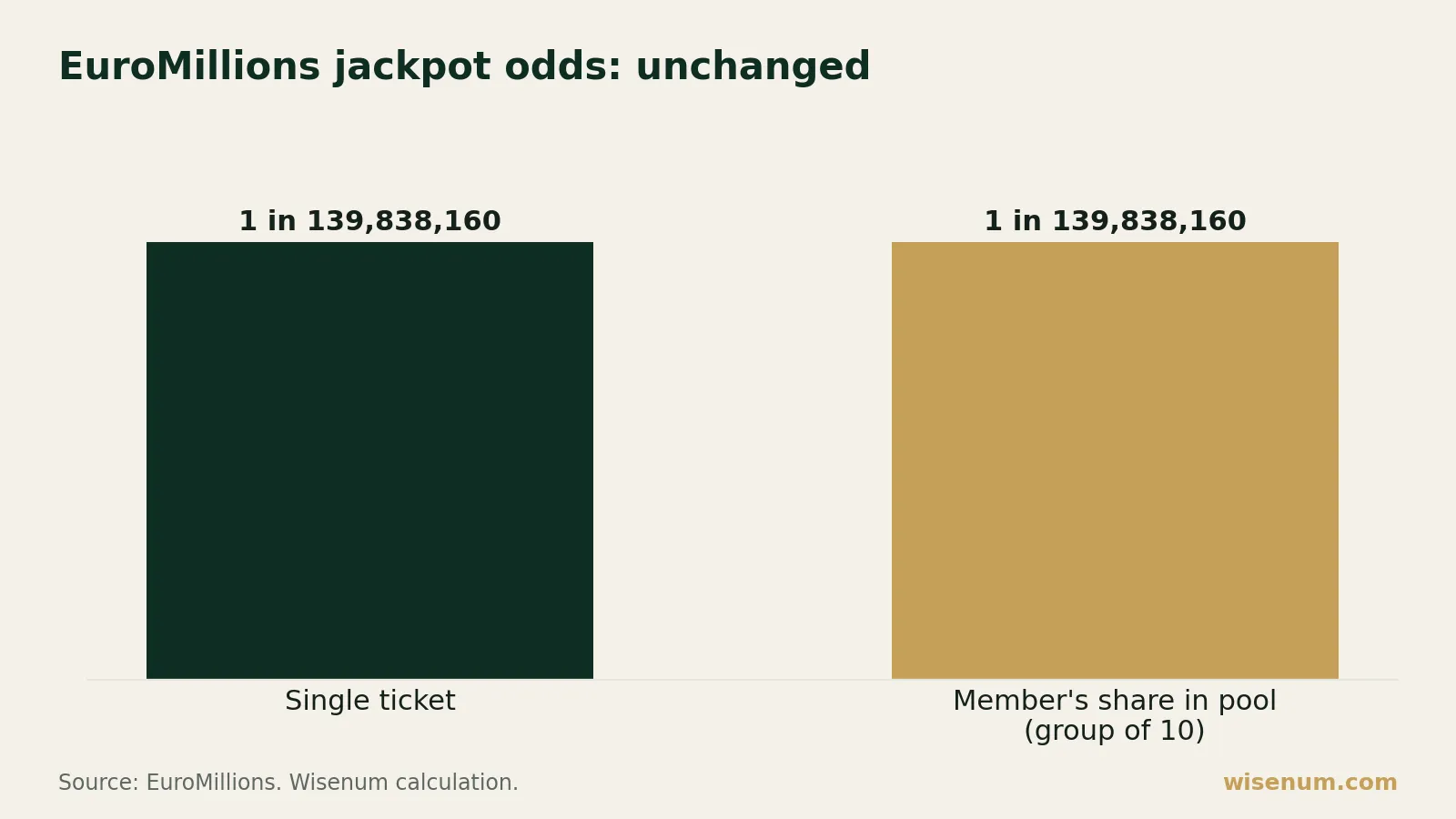
Here is how to organize a lottery pool without disputes: everything is written down and proven before the draw. Who pays what, who buys, who claims, how a win is split, and a photo of every ticket for every member. Playing in a group does not change the odds of a line: in EuroMillions, every line has a 1 in 139,838,160 chance of hitting the jackpot, whether it is paid for by one person or by ten. The group splits the cost and the prize, nothing else.
This guide is a practical companion to the complete guide to lottery pools and syndicates. It focuses on organization, on a point that is often overlooked (sharing a prize with other players), and on what Wisenum Pools offers.
The five steps to organize a pool
The New Jersey Lottery recommends writing the rules down before the first ticket (NJ Lottery, lottery pool best practices). Here is what to settle:
- The members and their contributions. Write down the name of each participant and what they pay in.
- The sharing rules. Each person's share, how rounding is handled, what happens to small prizes.
- One person in charge. They buy the tickets and keep the confirmations.
- The game and the duration. Say which game you play and for how many draws.
- The proof. Give each member a photo of every ticket, with the serial number on the back, before the draw.
One simple rule avoids many arguments: if you have not paid by the agreed date, you are not in that draw.
These rules aim at one thing: proof. If nobody can show what was bought, or when, trust rests on the word of a single person.
Calculating and sharing prizes fairly
The principle is strict division: everyone pays an equal share of the cost, and everyone receives the same share of the prize.
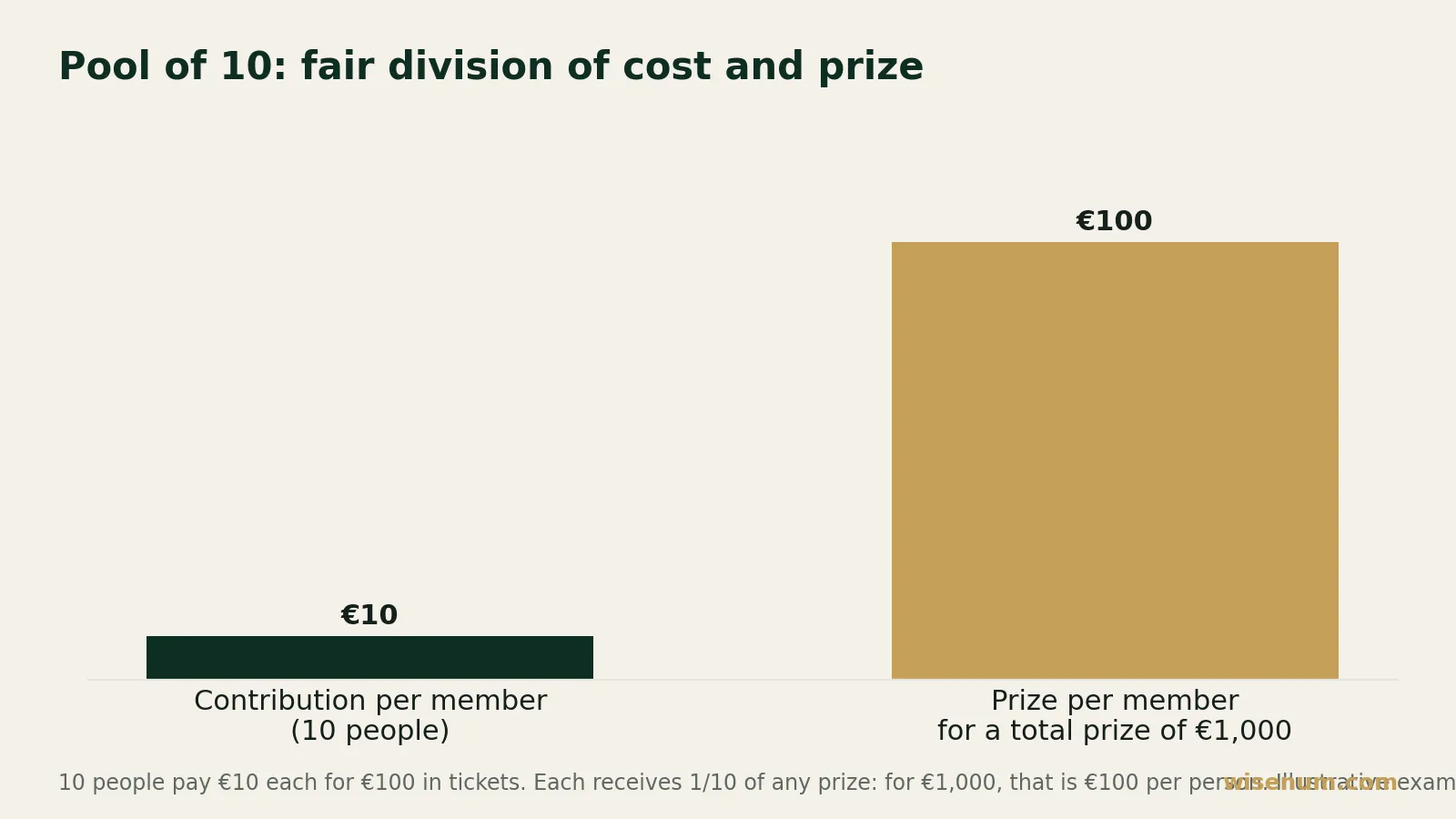
Example with 10 people who each pay €10 into a batch of tickets costing €100:
- each person put in €10 out of €100, or 1/10;
- each person is entitled to 1/10 of any group prize;
- for a €1,000 prize, each person receives 1,000 ÷ 10 = €100.
Write this calculation into the group agreement, along with how rounding is handled (for example, a €100 prize split between 3 people). Disagreement almost always comes from a case nobody had planned for.
The catch: a popular line means a prize split more ways
There is a second split, and the group does not control it. If several tickets across the whole draw win the same tier, the prize for that tier is divided among them, and then your share is divided among the pool members.
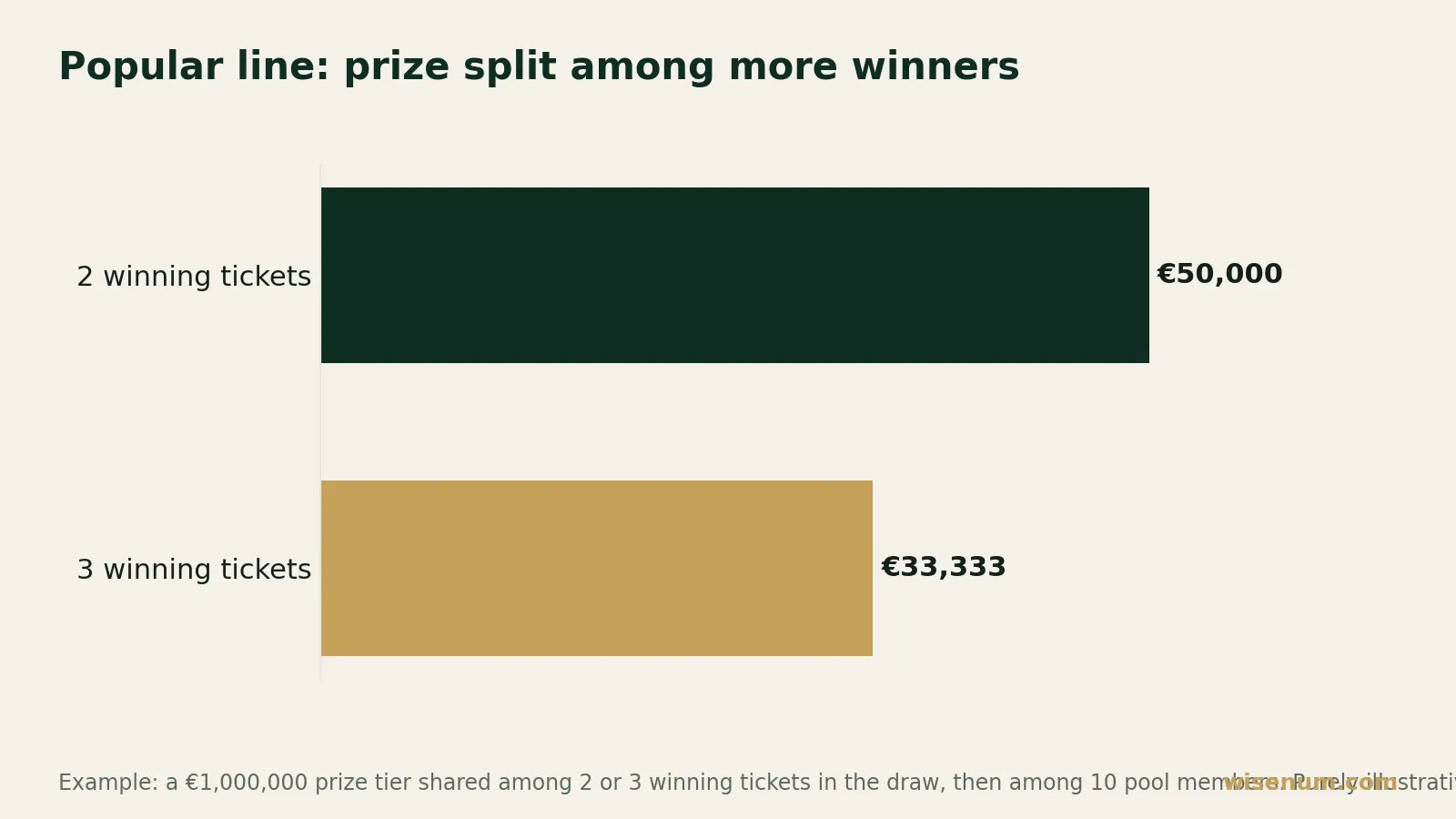
Take an illustrative example with numbers. One tier pays €1,000,000 to be shared:
- 2 winning tickets: €500,000 per ticket, or €50,000 per member in a pool of 10 (500,000 ÷ 10);
- 3 winning tickets: about €333,333 per ticket, or about €33,333 per member.
The probability of drawing the line is the same in both cases. Only the number of people you share with changes. And players do not choose at random: birthdays, for example, concentrate choices on 1 to 31.
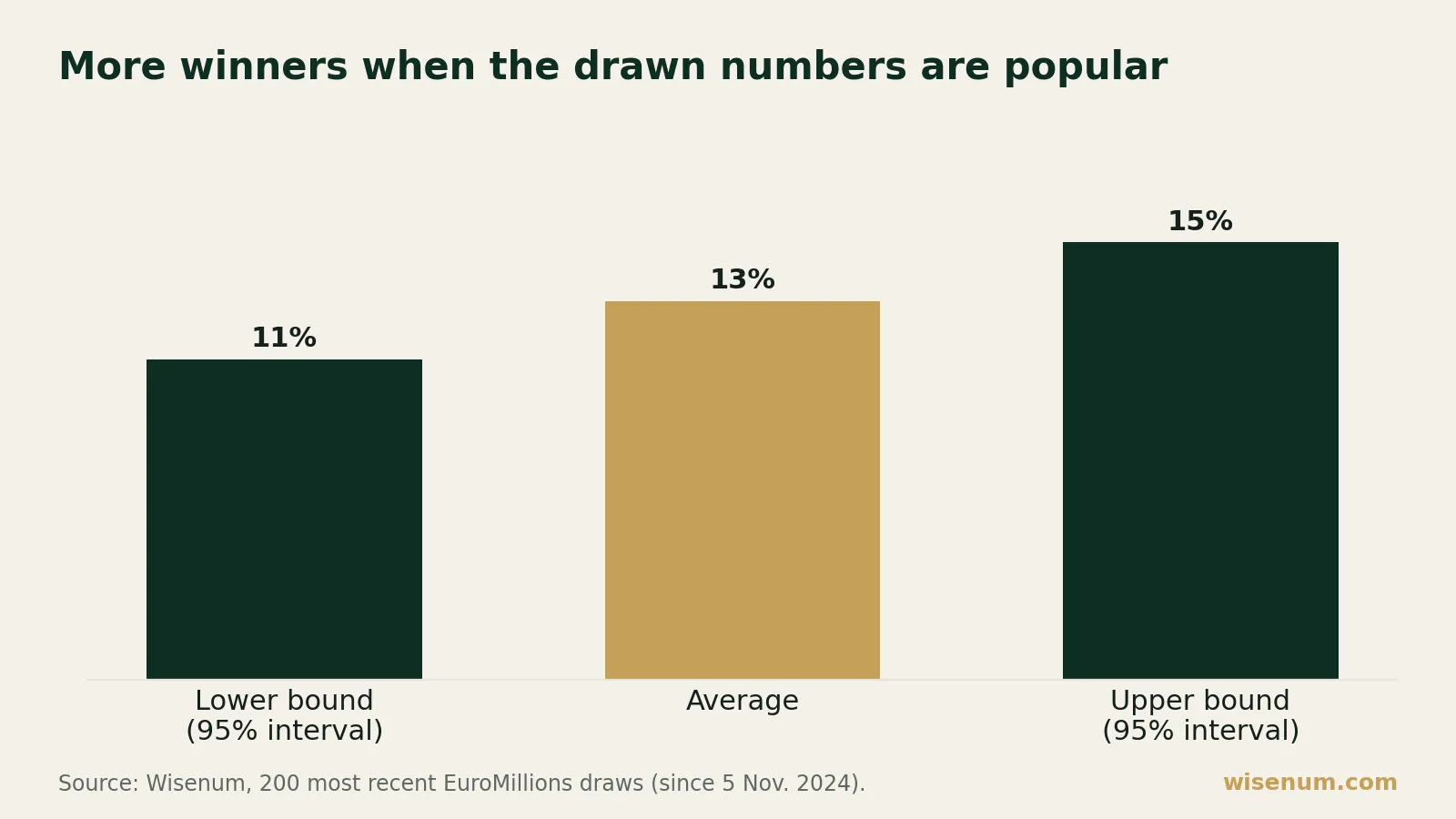
Wisenum data shows this at the scale of the game. Over the last 200 EuroMillions draws (since November 5, 2024), when the drawn numbers were among those Wisenum rates as the most played, there were on average 13% more winners at equal participation (95% interval: 11% to 15%, comparing the 50 draws rated most played with the 50 rated least played). That is an indicator value of 1.128, or 12.8% rounded to 13%, with an interval of 1.108 to 1.149. Source: Wisenum EuroMillions popularity model, 2026.
This does not make any draw more likely. It means a rarely played line is less exposed to prize sharing, which matters for a group too.
Wisenum Pools: draw certification and verification by members
Wisenum Pools lets you prepare and share a group's lines. Wisenum never buys tickets: buying remains the job of the person in charge of the pool. The tool helps prepare lines and make them verifiable. Its two main strengths answer the three real problems of a pool: trust between members, proof of the lines played, and control over winnings.
1. Draw certification for the pool
Draw certification for the pool relies on locking and timestamping the lines before the official draw time. The timestamp shows that the lines were fixed before the results were known. It answers three classic suspicions:
- the pool's lines were fixed before the official draw;
- no line was added or changed afterwards;
- the pool owner did not change the picks once the results were known.
2. Verification by members
Every pool has a timestamped verification link: a public, read-only page that lists all the locked lines. Any member can open it and check the group's lines for themselves. Trust no longer rests on one person's word: everyone can verify.
What a pool also offers
According to the Wisenum Pools page, every plan includes:
- a comparison of the estimated popularity of lines;
- avoidance of duplicate combinations;
- locking of lines before the draw;
- CSV and Excel export;
- printable play sheets.
Among the plans, Pool Starter is for family or friend groups of 5 to 10 people, and Pool Pro for office groups of 15 to 50 people or more. The number of lines per draw and the prices depend on the plan: see the pricing page for current terms.
Wisenum Pools does not change the probability of your lines and promises no prize. It makes the pool clearer and easier to check.
The takeaway
- A pool without disputes rests on rules written before the first ticket: members, contributions, sharing, person in charge, proof.
- The math is simple: an equal share of the cost, an equal share of the prize. A €1,000 prize among 10 members is €100 each.
- A line played in a group has the same probability as a line played alone: 1 in 139,838,160 for the EuroMillions jackpot.
- A tier prize can be split among several winning tickets in the draw: a rarely played line reduces the risk of sharing, without promising anything.
- What protects a group is proof: lines fixed before the draw that every member can verify.
Playing the next draw? See whether your line looks like the most common picks: Analyze a line
Play for fun, and only spend what you can afford to lose. Responsible gambling support: in the US, call 1-800-GAMBLER (ncpgambling.org); in the UK, visit BeGambleAware.
Frequently asked questions
What is a lottery pool and how does it work?
A lottery pool is a group of people who chip in to buy tickets together. The cost and the prizes are shared fairly according to each person's contribution. For example, with 10 people who each pay €10 for €100 of tickets, each person receives 1/10 of every prize. Playing in a group does not change the probability of your line: in EuroMillions, it stays 1 in 139,838,160.
What are the five essential steps to organize a pool without disputes?
The five steps are: (1) write down the names of all members and what each one pays in, (2) agree on the sharing rules and how rounding is handled, (3) name one person in charge who buys the tickets, (4) state which game you play and for how many draws, (5) give each member a photo of every ticket before the draw. Putting these precautions in writing helps avoid disputes.
Why can a popular line reduce my prize in a pool?
When the winning numbers are heavily played (like birthdays), more people win the same tier in a draw. That prize is divided among all the winning tickets, and then your share is divided among the members of your pool. Over the last 200 EuroMillions draws, there were on average 13% more winners at equal participation when the drawn numbers were among those Wisenum rates as the most played (95% interval: 11% to 15%). A rarely played line is therefore less exposed to prize sharing.
How does Wisenum Pools help a group trust each other?
Wisenum Pools offers two key features: (1) locking and timestamping the pool's lines before the official draw time, which shows that no line was added or changed after the results, and (2) a verification link, a public read-only page that every member can open to check the group's lines for themselves. Trust no longer rests on one person's word.
Does Wisenum Pools change the probability of winning or promise a prize?
No. Wisenum Pools does not change the probability of your lines and promises no prize. It simply makes the pool clearer and easier to check by locking and timestamping the lines before the draw. The draw and the probabilities stay the same.
Every valid combination has the same probability of being drawn. Wisenum does not predict winning numbers.
Sources
- Jouer en groupe : pools et syndicats de loterie expliqués · Wisenum
- Pools · Wisenum (French)
- Pools · Wisenum (English)
- Peñas · Wisenum (Spanish)
- Tarifs · Wisenum (French Pricing)
- Pricing · Wisenum (English Pricing)
- Precios · Wisenum (Spanish Pricing)
- NJ Lottery | Lottery Pool Rules (Official Best Practices Guide)