Lottery pools and syndicates: costs and winnings are divided, the odds per ticket stay the same. Written agreements, sharing rules, budget, responsible play.
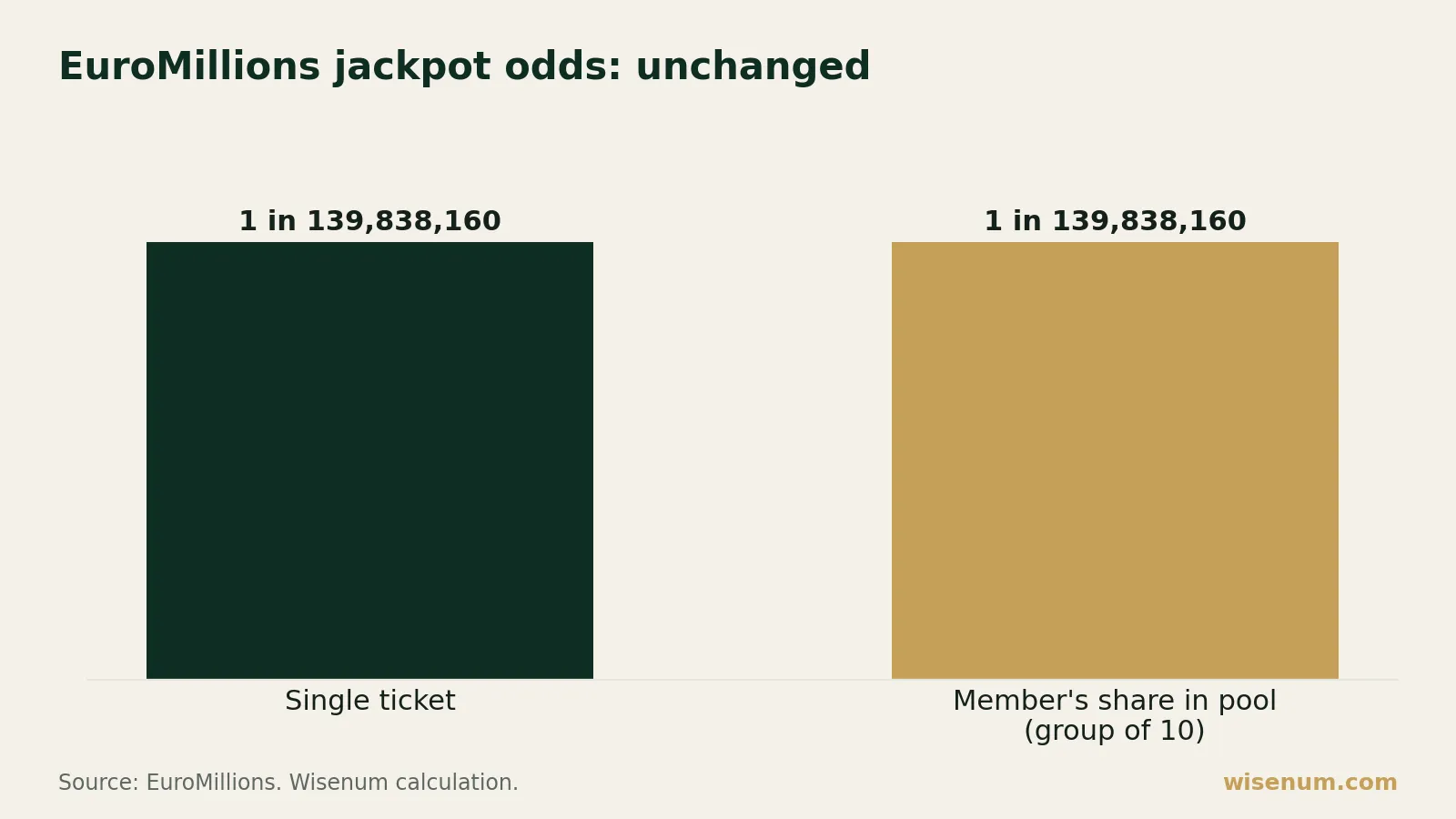
Playing in a group changes two things: what each person pays and the size of each person's share of a win. One thing stays the same: the probability of a line. In EuroMillions, every line has a 1 in 139,838,160 chance of winning the jackpot, whether it was bought by one person or by ten. Lottery pools and syndicates work on the same principle: costs and winnings are divided equally. Here is how that works, what the division really changes, and how to avoid disputes.
Pool or syndicate: what are we talking about?
A pool (or syndicate) is a group of people who buy one or more tickets together, then share any winnings. Two situations are worth telling apart.
- The private group: colleagues, friends, family. They can play together without a licence. What is regulated is offering syndicates to the public as a commercial service: that falls to operators authorised by the country's regulator (the Gambling Commission in the UK, the Autorité nationale des jeux in France) (source).
- The group format offered by the operator: in France, the Française des Jeux offers an official "Jeu en groupe" (group play) option for draw games such as Loto and EuroMillions. It falls under the draw-game rules published by the operator (FDJ EuroMillions rules).
Rules vary from country to country. In Western Australia, for example, the Powerball rules (Lotteries Commission) define a syndicate entry as a ticket divided into equal shares: at least 10 shares, with a minimum price of AUD 2.50 per share (official rules). Before you start, check the terms of your own country's operator.
Costs and winnings: everything is divided the same way
The principle is strict division. Everyone pays an equal share of the cost, and everyone receives the same share of any win (source).
Take 10 people who each put in €10 for a batch of tickets costing €100:
- each person put in €10 out of €100, or 1/10;
- each person is entitled to 1/10 of any win by the group;
- a €1,000 win therefore comes to €100 per person (1,000 ÷ 10).
The same calculation applies to Australian Powerball: for a AUD 25 ticket split into 10 shares, each share costs AUD 2.50 (25 ÷ 10) and receives one tenth of the win.
One practical detail: the Australian Powerball rules provide that each person's share is rounded to the nearest cent, and that the total distributed is preserved. That is one more reason to write down in advance who receives any remainder.
The probability does not change, the number of lines does
A ticket has the same probability of winning whether one person or ten paid for it. What a pool changes is the number of lines the group plays and the size of each person's share.
Imagine a group of 10 people playing 10 different EuroMillions lines:
- each line has a 1 in 139,838,160 chance of winning the jackpot;
- the group holds 10 combinations: 10 ÷ 139,838,160 = 1 in 13,983,816, which is 139,838,160 ÷ 10 (check: 13,983,816 × 10 = 139,838,160);
- if one of them wins, each person receives 1/10 of the prize.
In other words, the group plays 10 lines instead of one, but each person receives 10 times less if there is a win (source). Each member holds only one tenth of those 10 lines, the equivalent of one line. The pool therefore gives no advantage: only the shape of the win changes, with shares that are hit more often but are smaller.
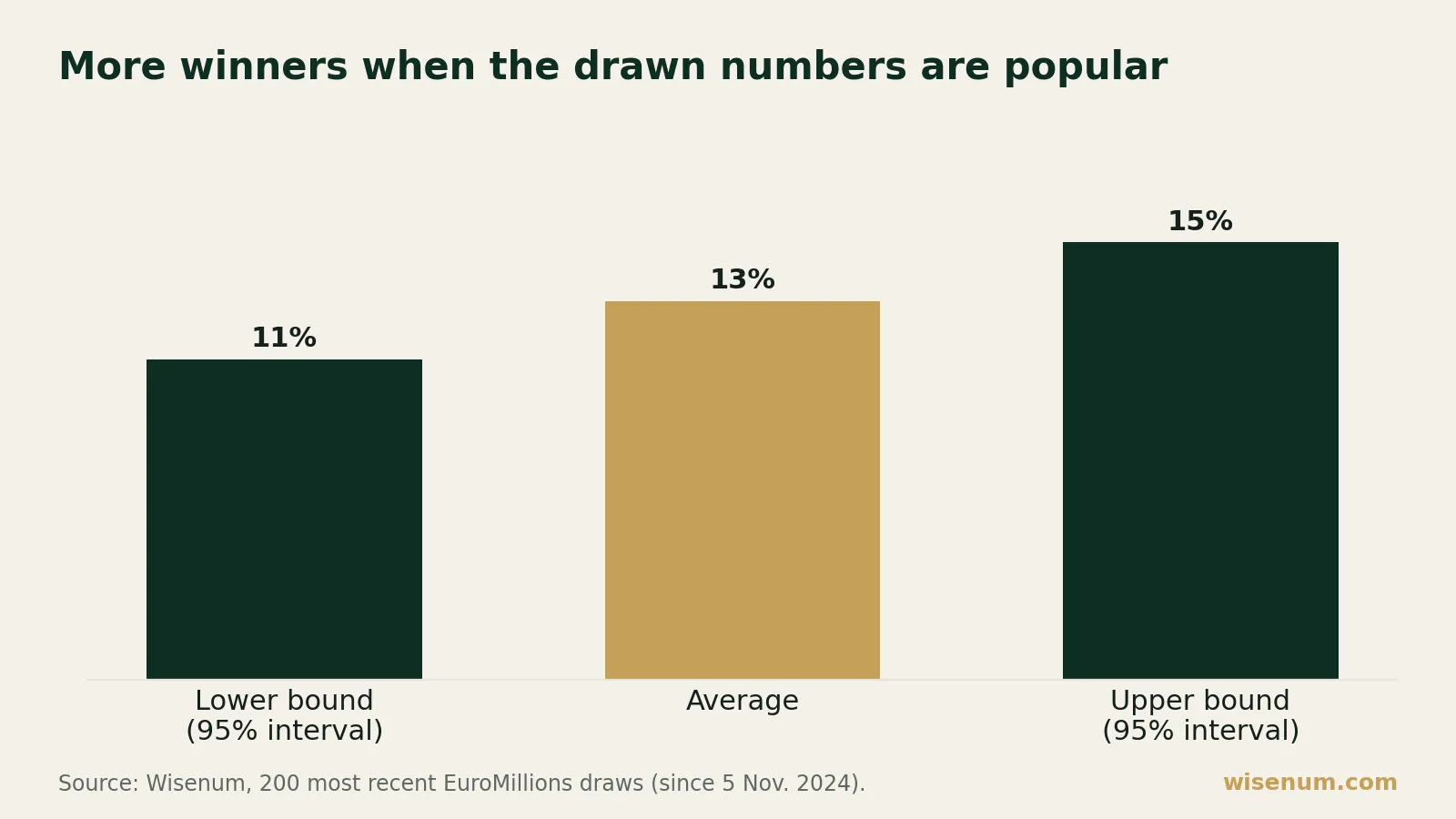
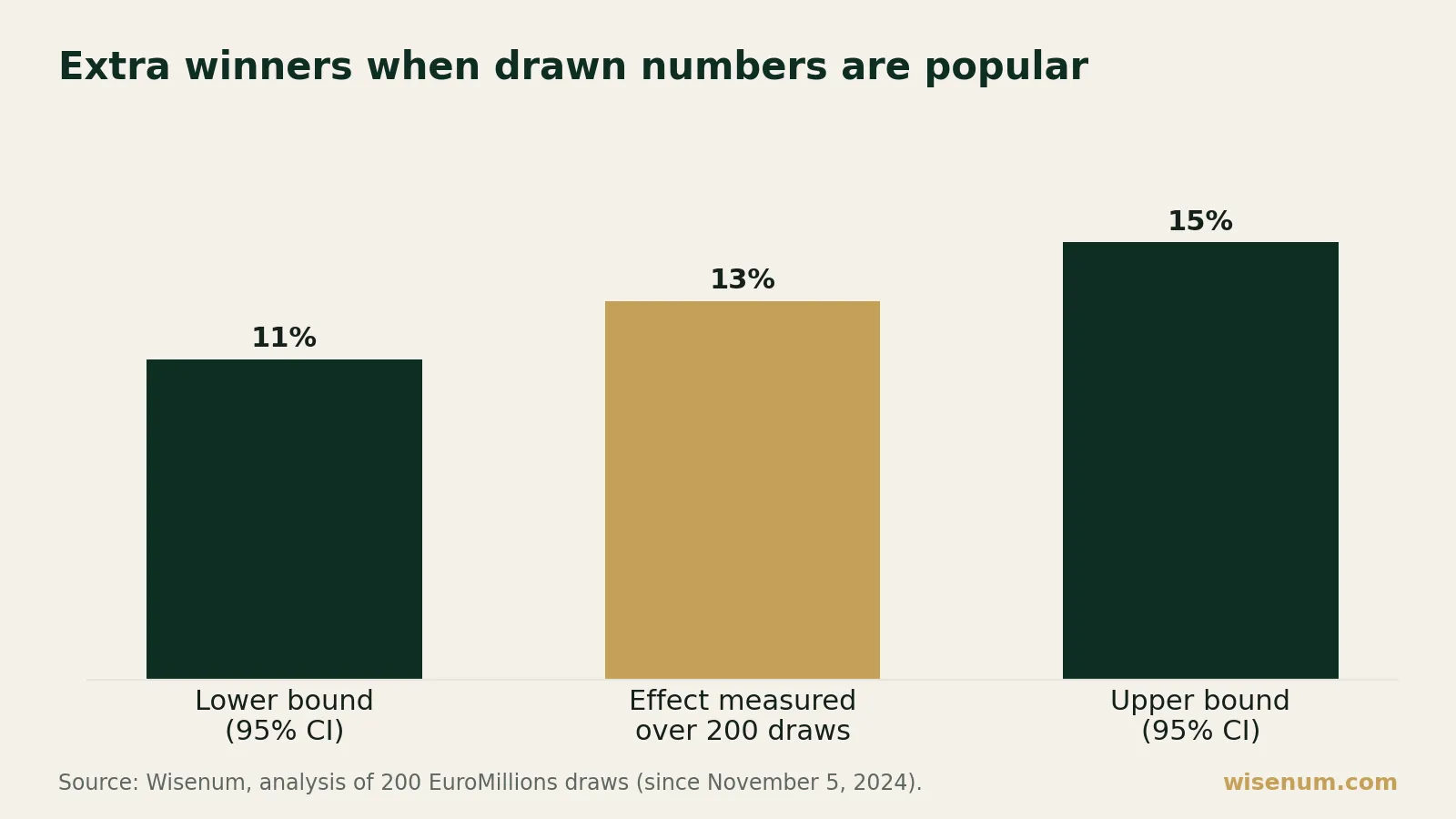
A pool does not protect you from sharing with other winners either. If the group's numbers are popular, the prize is divided among the winners of the same tier, then among the pool members. Wisenum measured this effect on EuroMillions: over the last 200 draws (since November 5, 2024), when the drawn numbers were among those Wisenum rates as most played, there were on average 13% more winners, at equal participation (95% interval: 11% to 15%, comparing the 50 draws rated most played with the 50 rated least played). The details of the calculation are in Wisenum's methodology. To understand the mechanism, read how shared jackpots happen when many players choose the same numbers.
Disputes and good practice: the written agreement
A documented case
In January 2025, a court in British Columbia (Canada) ruled that an employee did not have to share a C$2 million win with his colleagues. The winning ticket had been paid for with C$10 of his own money, not with the usual C$50 from the pool. Nothing showed that the group's money had been used. The judge accepted that the colleagues might feel a moral entitlement, but found they had not established a legal one (Global News). The BC Lottery Corporation recommends that groups keep written rules and records.
The other documented pool disputes (Windsor in Ontario, Youngstown in Ohio in 2011) have the same thing in common: no written agreement and no clear paperwork before the draw.
The rules to write down before the first ticket
The recommendations of the New Jersey Lottery and other regulators converge (NJ Lottery). Here is a version to adapt to your group:
- Who plays. Write down the names of all members and what each person contributes.
- The sharing rules. Agree on them in advance: each person's share, how rounding is handled, what happens to small prizes.
- A manager. Name the person who buys the tickets and keeps the confirmations.
- The game and the frequency. Specify which game you play, and for how many draws.
- The tickets. Each member gets a photo of every ticket (with the serial number on the back) before the draw. The original is kept somewhere safe.
Add one simple rule: no payment by the agreed date, no share in that draw. The guides we consulted present it as the best defence against conflict after a win (source).
Without a written agreement, payment histories, member lists, group messages and photos of tickets can serve as evidence. But they leave more room for disagreement.
A tax point to check
In the UK, HMRC's Statement of Practice E14 provides that, if the sharing follows an arrangement that existed before the win, each member receives their share of the winnings. Without such an arrangement, the payment may be treated as a gift from the person who collected it. The advice is to record the agreement in a written, signed and dated document before buying a ticket (source). Tax treatment depends on your country: check with your local tax authority.
Budget and responsible play
The pool divides the cost, but it does not make playing cheaper in absolute terms. Ten people who each play €10 every week spend €100 a week between them. So set a budget per member, and leave everyone free to leave the group before the next draw. Nobody should feel pushed to stay or to put in more so as not to "let the others down".
The takeaway
- In a pool, cost and winnings are divided in equal shares. The probability of each line does not change: 1 in 139,838,160 for the EuroMillions jackpot.
- The group plays more lines, but each person receives a smaller share. That creates no advantage.
- Documented disputes come from a lack of proof, not from the game itself. A written agreement, the list of members, contributions and photos of the tickets before the draw prevent them.
- Set a budget per member. Playing in a group is first of all a shared moment.
Organising a group of players? Discover Wisenum Pools
Play for fun, and only spend what you can afford to lose. Responsible gambling support: in the US, call 1-800-GAMBLER (ncpgambling.org); in the UK, visit BeGambleAware.
Frequently asked questions
Does playing in a pool change the probability of winning?
No. The pool divides the cost and the winnings, but each line keeps the same probability. A group of 10 people playing 10 lines gives each person 1/10 of any win: each member holds the equivalent of one line. The pool creates no advantage; only the shape of the win changes.
What causes disputes in lottery pools?
The lack of written records and of proof of contributions. In January 2025, a court in British Columbia ruled that an employee did not have to share a C$2 million win with his colleagues, because there was no proof that the group's money had been used. A written agreement and photos of the tickets before the draw help avoid these conflicts.
What are the 5 essential rules of a pool?
1. Write down everyone's name and contribution. 2. Agree on the sharing rules. 3. Name a manager. 4. Specify the game and the frequency. 5. Give each member a photo of every ticket before the draw. Add the rule "no payment by the agreed date, no share in that draw".
Are there tax implications to playing in a pool?
It depends on your country. In the UK, if the sharing follows an arrangement that existed before the win, each member receives their share without the payment being treated as a gift; the advice is to record that agreement in writing, signed and dated, before buying a ticket. Check with your local tax authority.
Does a pool change the risk of sharing a jackpot?
No. If the pool's numbers are popular, the prize is divided among the winners of the same tier, then among the pool members. Over the last 200 EuroMillions draws, there were on average 13% more winners when the drawn numbers were among those Wisenum rates as most played (95% interval: 11% to 15%).
Every valid combination has the same probability of being drawn. Wisenum does not predict winning numbers.
Sources
- EuroMillions Syndicates — How They Work + Free Agreement
- EuroMillions Syndicates: Definition, Legal Framework, and Online Participation (Official Data)
- FDJ Règlement EuroMillions - My Million, Etoile+ (Officiel)
- Lotteries Commission (Powerball) Rules 1996, Part 2A — Syndicate Entries (Official Australian Regulation)
- B.C. Court Rules on Disputed $2M Lottery Pool Win (Mandeep Singh Maan v. Co-workers, January 2025)
- NJ Lottery | Lottery Pool Rules (Official Best Practices Guide)
- Do You Need a Written Agreement for a Lottery Syndicate? (HMRC Statement of Practice E14 and UK Gambling Commission Guidance)
- Image : File:Filling lottery ticket 20180215.jpg (CC BY-SA 4.0, Wikimedia Commons)