What happens to lottery winners? Bankruptcies, taxes and an operator's guidance after a win, based on published studies.
What happens to lottery winners? In the landmark study, winners of $50,000 to $150,000 were 50% less likely to file for bankruptcy within two years than small winners. But that advantage fades: over the full six years, the overall bankruptcy rate does not differ between the two groups. This article covers what the published research says, the tax orders of magnitude and one operator's guidance, with no winner stories and no promises.
Bankruptcy: short-term relief, then nothing
The study by Hankins, Hoekstra and Skiba, "The Ticket to Easy Street? The Financial Consequences of Winning the Lottery" (Review of Economics and Statistics, 2011), looks at Florida lottery winners (Fantasy 5 game) between 1993 and 2002. The authors compare winners of $50,000 to $150,000 with small winners, under $10,000 (source).
Three results stand out:
- 0 to 2 years after the win: winners of $50,000 to $150,000 are 50% less likely to file for bankruptcy than small winners.
- 3 to 5 years after the win: the bankruptcy rate of winners of $50,000 to $150,000 becomes higher.
- Over the whole six-year period: no significant difference in the overall bankruptcy rate between the two groups.
The authors also note that the winners of $50,000 to $150,000 who did end up filing had, at that point, the same level of unsecured debt (debt not backed by an asset) and the same net worth as the small winners. The win was therefore not used to pay down debt for good; it was spent. Their conclusion: a large cash payment postpones bankruptcy more than it prevents it.
These amounts are modest compared with a jackpot, and they concern a single US state. The study says nothing about a win of several million dollars.
How winners use their winnings
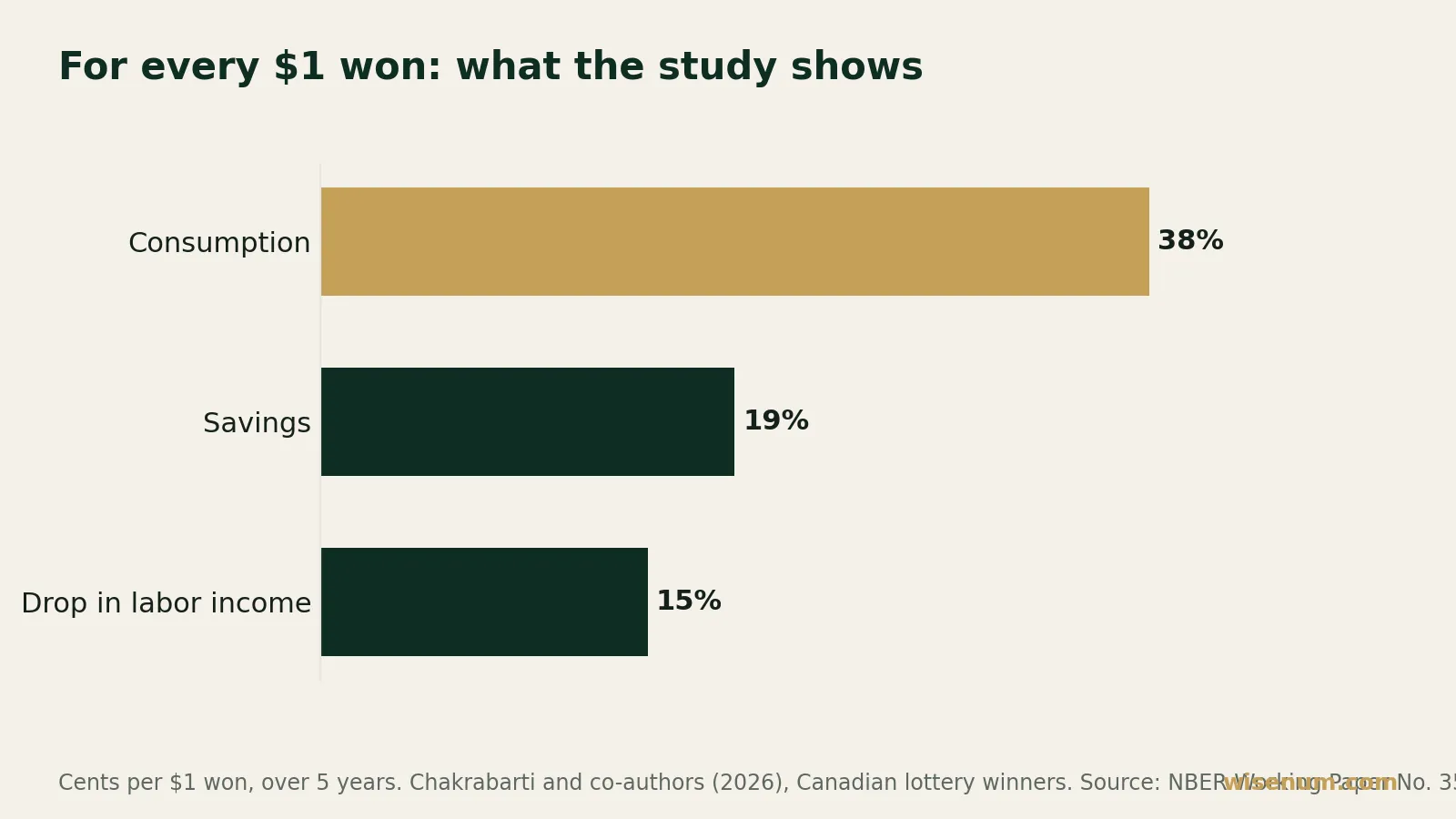
Another study gives a more detailed picture. Chakrabarti, d'Astous, Kroft and co-authors (2026, "Consumption, Savings, and Earnings Responses to Financial Windfalls", NBER Working Paper No. 35836) analyze Canadian lottery winners (source). Over five years, for every $1 won:
- 38 cents go to consumption;
- 15 cents correspond to a drop in labor income;
- 19 cents go to savings: 9 cents of debt repayment and 10 cents of investments.
High-income winners put a larger share toward savings and leisure, while low-income winners put a larger share toward consumption.
A third study, by Agarwal, Mikhed and Scholnick (2020, Review of Financial Studies), looks at the people around winners: lottery wins increase borrowing and bankruptcies among neighbors with comparable incomes (source).
What an operator advises after a big win
The French operator Française des Jeux (FDJ) created its "Relations Gagnants" (Winner Relations) service in 1993. About 360 winners of €500,000 or more are identified there each year, including 180 millionaires (source).
- From €500,000 to €1,000,000: a reception organized in the winner's region, plus presentation videos on wealth management and taxation.
- From €1,000,000: one-to-one support at the time of the win, then collective follow-up for at least 5 years, with workshops about 20 times a year (financial management, taxation, investments, notarial law, asset protection).
- Also offered: discussion groups between former and new winners, and psychological support for the emotions and life changes that come with a win (source).
The service is anonymous and free. The advice that comes up again and again: don't rush, and take time to decide.
Annuity or lump sum, and what is left after tax
In the United States, the advertised jackpot is not the amount received. According to Lottery Atlas's analysis (source), the annuity is paid in 30 installments spread over 29 years, each rising by 5% a year. The lump sum (the "cash option") is about 41% to 43% of the advertised amount, depending on interest rates.
On the tax side, the IRS applies 24% federal withholding to winnings above $5,000 (source). The actual marginal rate can reach 37% (2026 federal brackets). Here is the worked example from National Tax Tools (source), for an advertised $100 million jackpot taken as a lump sum, or about $42 million:
- withholding: 24% × $42M = $10.08M;
- estimated federal tax, applying 37% to the whole amount: 37% × $42M = $15.54M;
- balance due when filing the return: 15.54 − 10.08 = $5.46M;
- amount left: 42 − 15.54 = $26.46M, or about 26 cents per advertised dollar, in a state with no tax on winnings.
These figures apply to the United States and do not carry over as they are to other countries: for a specific win, the reference is the tax authority of the country concerned.
Sharing a win, another gap between the headline and the amount received
Tax is not the only difference between the advertised figure and the amount received. When several players hold the same winning combination, the jackpot is divided. With an advertised $100 million jackpot and two winners, each receives half, or $50 million, before the lump sum and taxes. The same steps as above then apply to that half.
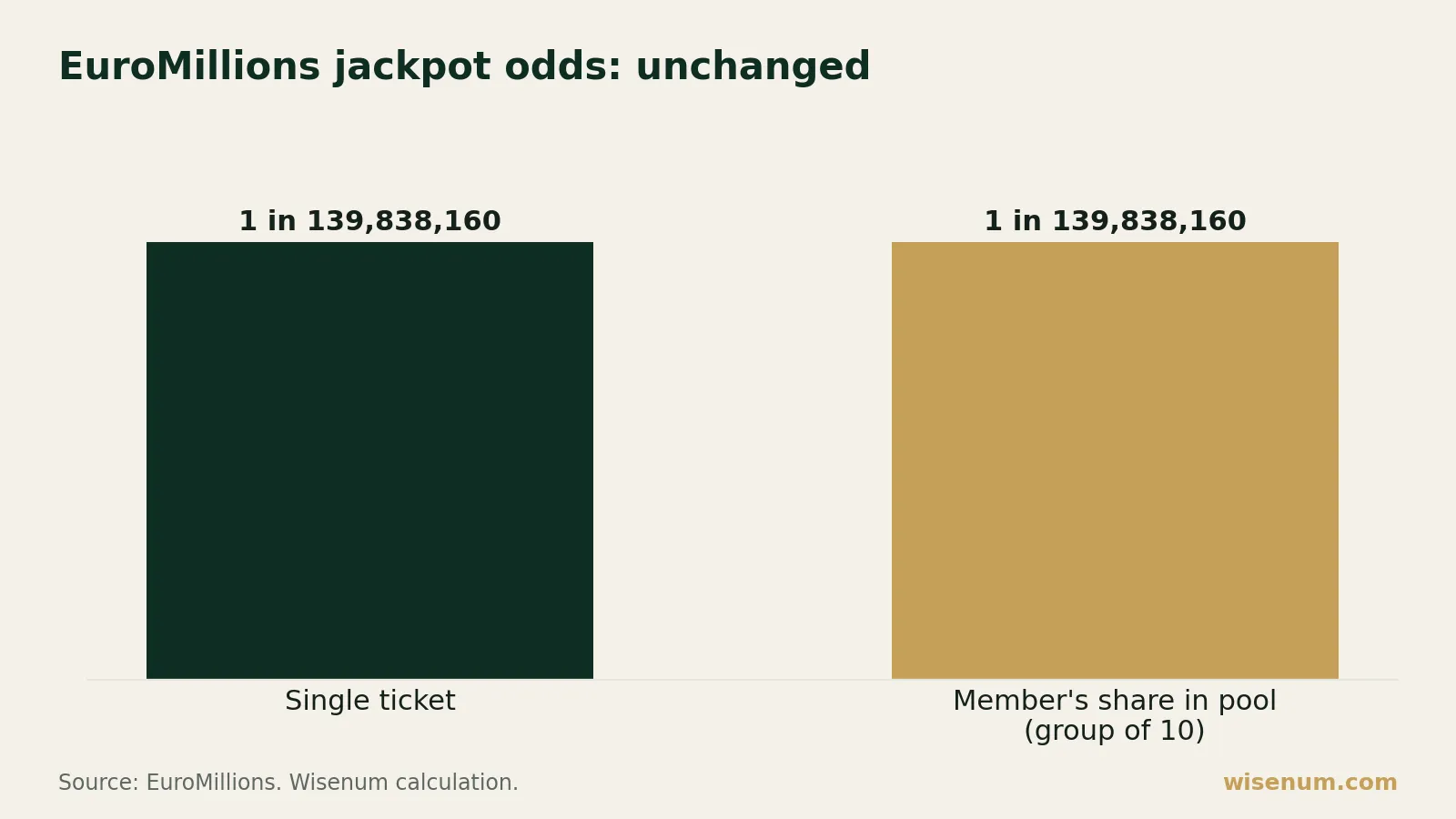
The odds do not change: every combination has the same probability. What varies is how many players picked the same line. To understand why big jackpots are shared more often, read our article on why big jackpots are shared more often.
The takeaway
Published studies describe behavior, not destiny. In Florida, a win of $50,000 to $150,000 postponed bankruptcies without changing the six-year outcome. In Canada, out of every $1 won, 38 cents go to consumption and 19 cents to savings. And an advertised jackpot is not the final sum: the form of payment, tax and sharing among winners all reduce it. FDJ recommends taking time to decide and offers support. These results come from specific samples (Florida, Canada) and do not apply to every winner.
Playing the next draw? See whether your line looks like the most common picks: Analyze a line
Play for fun, and only spend what you can afford to lose. Responsible gambling support: in the US, call 1-800-GAMBLER (ncpgambling.org); in the UK, visit BeGambleAware.
Frequently asked questions
Does winning the lottery lead to bankruptcy?
Not according to the 2011 study by Hankins, Hoekstra and Skiba on Florida. Winners of $50,000 to $150,000 were 50% less likely to file for bankruptcy within two years than small winners, but the overall bankruptcy rate over six years does not differ between the two groups.
How much of an advertised jackpot is left after tax?
In the National Tax Tools example, an advertised $100 million jackpot taken as a lump sum (about $42 million) leaves about $26.46 million after 37% federal tax, or about 26 cents per advertised dollar, in a state with no tax on winnings. These figures apply to the United States.
What does FDJ offer to winners?
Since 1993, FDJ's anonymous, free "Relations Gagnants" service has supported winners. From €1,000,000, it offers one-to-one support, then collective follow-up for at least 5 years, discussion groups and psychological support. The advice that comes up again and again: don't rush.
How do Canadian winners use their winnings?
According to Chakrabarti and co-authors (2026), over five years, for every $1 won, 38 cents go to consumption and 19 cents to savings (9 cents of debt repayment, 10 cents of investments). 15 cents correspond to a drop in labor income.
Does the amount received go down if other players also win?
Yes. When several players hold the same winning combination, the jackpot is divided. With an advertised $100 million jackpot and two winners, each receives $50 million, before the lump sum and taxes.
Every valid combination has the same probability of being drawn. Wisenum does not predict winning numbers.
Sources
- Hankins, Hoekstra & Skiba (2011) - The Ticket to Easy Street? The Financial Consequences of Winning the Lottery
- Chakrabarti, d'Astous, Kroft et al. (2026) - Consumption, Savings, and Earnings Responses to Financial Windfalls
- Agarwal, Mikhed & Scholnick (2020) - Peers' Income and Financial Distress: Evidence from Lottery Winners
- FDJ UNITED - Grands gagnants et accompagnement
- FDJ - Comment percevoir ses gains et services aux gagnants
- IRS - Instructions for Forms W-2G and 5754 (Gambling Winnings and Withholding)
- National Tax Tools - Lottery Winnings Tax Guide 2026
- Lottery Atlas - Jackpot Cash Value vs Advertised Prize Analysis