Secondary prizes shared or fixed? Outside California, Powerball and Mega Millions lower tiers are fixed; in Europe, every tier is split.
Are lottery secondary prizes shared too? It depends on the game. In Powerball and Mega Millions, the tiers below the jackpot pay fixed amounts: Powerball's Match 5 is worth $1 million whether you are the only winner or one of ten. In Europe, these are secondary prizes shared between winners: in EuroMillions and EuroJackpot, every tier is a slice of a common prize fund, divided among the winners of that tier. Only the amount you receive is affected: every combination has the same probability.
In the US: fixed tiers in Powerball and Mega Millions
In Powerball, only the jackpot varies. The other tiers pay an amount announced in advance, for example: $1,000,000 for Match 5, $50,000 for Match 4 + Powerball, $100 for Match 4 or Match 3 + Powerball, $7 for Match 3 or Match 2 + Powerball, and $4 for Match 1 + Powerball (official prize chart).
The October 3, 2026 draw gives a concrete example: a ticket bought in Arizona won exactly $1 million at the Match 5 tier (official result). If two tickets in another state had matched all five numbers, each would also have received $1 million. Our analysis of that draw covers the result in detail.
Mega Millions works the same way for tiers 2 to 9: $2,000,000 for Match 5, $20,000 for Match 4 + Megaball, $1,000 for Match 4, $400 for Match 3 + Megaball, $20 for Match 3 or Match 2 + Megaball, $14 for Match 1 + Megaball and $10 for Match 0 + Megaball (official prize chart).
One caveat: the reduction clause
"Fixed" does not mean "unconditional." Powerball's rules provide that if the prize pool is not enough, the highest fixed tiers, starting with Match 5, switch to parimutuel one after another until the available funds cover the payouts (Powerball rules, District of Columbia version). Mega Millions has a similar mechanism: the liability cap can switch tiers 2 and 3 to parimutuel (official Mega Millions rules). This is a fallback rule, not the usual way the games work.
California: everything is parimutuel
California is the exception. In that state, the Powerball and Mega Millions tiers that are fixed elsewhere are converted to parimutuel: the amount depends on ticket sales and on the number of winners (KTLA). For Mega Millions, this covers tiers 2 to 9.
So the same Match 5 ticket does not necessarily pay $1 million in Powerball if it was bought in California: the prize can be different, depending on the draw.
In Europe: every tier is divided among its winners
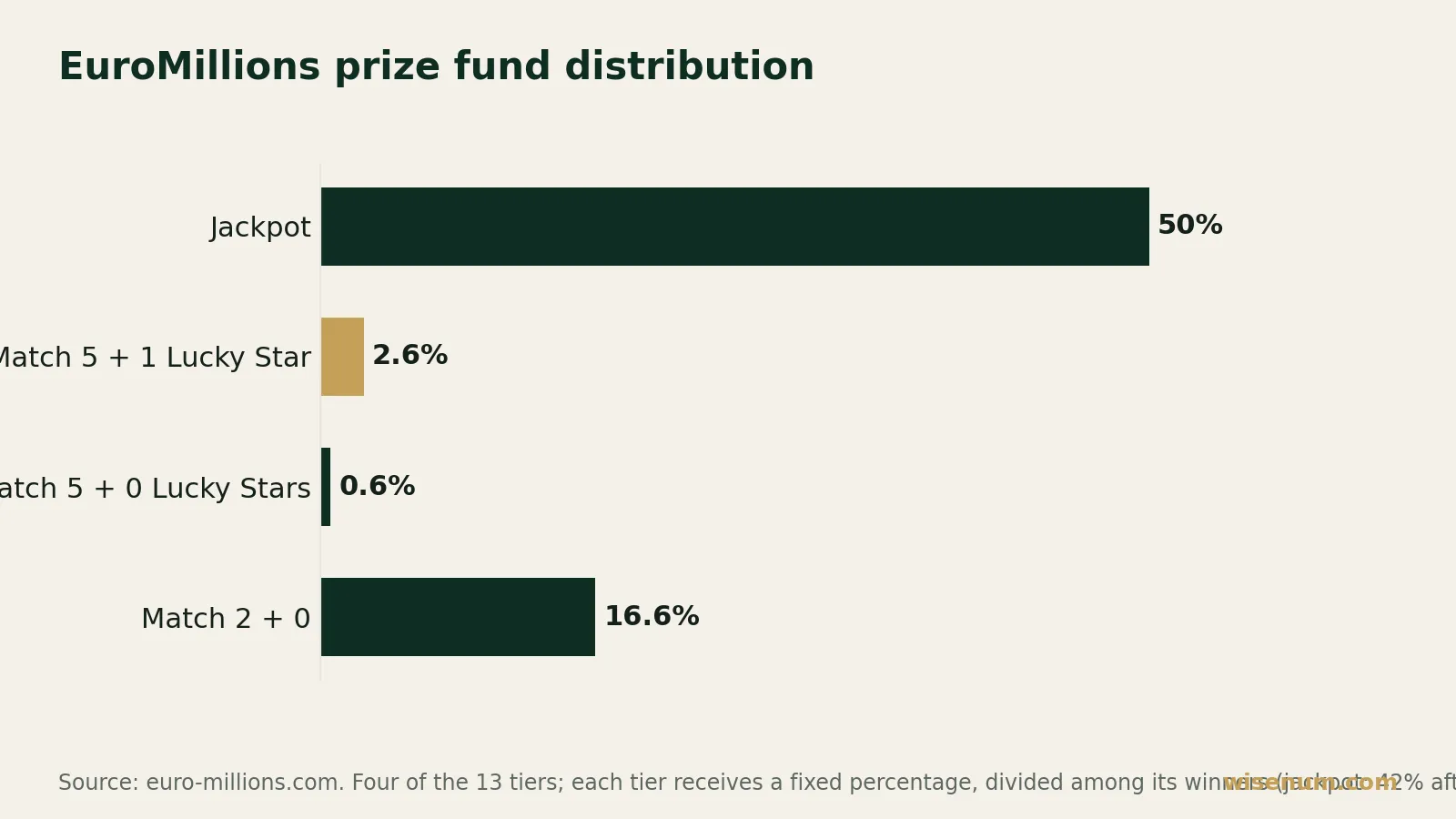
EuroMillions and EuroJackpot have no fixed amount for any prize tier. Each tier receives a percentage of the common prize fund, and that amount is then divided among the winners of the tier.
- EuroMillions: 13 tiers. The jackpot receives 50% of the fund (42% after five rollovers), the Match 5 + 1 Lucky Star tier 2.61%, the Match 5 + 0 Lucky Stars tier 0.61%, and so on down to the Match 2 + 0 tier, which receives 16.59% (prize fund distribution).
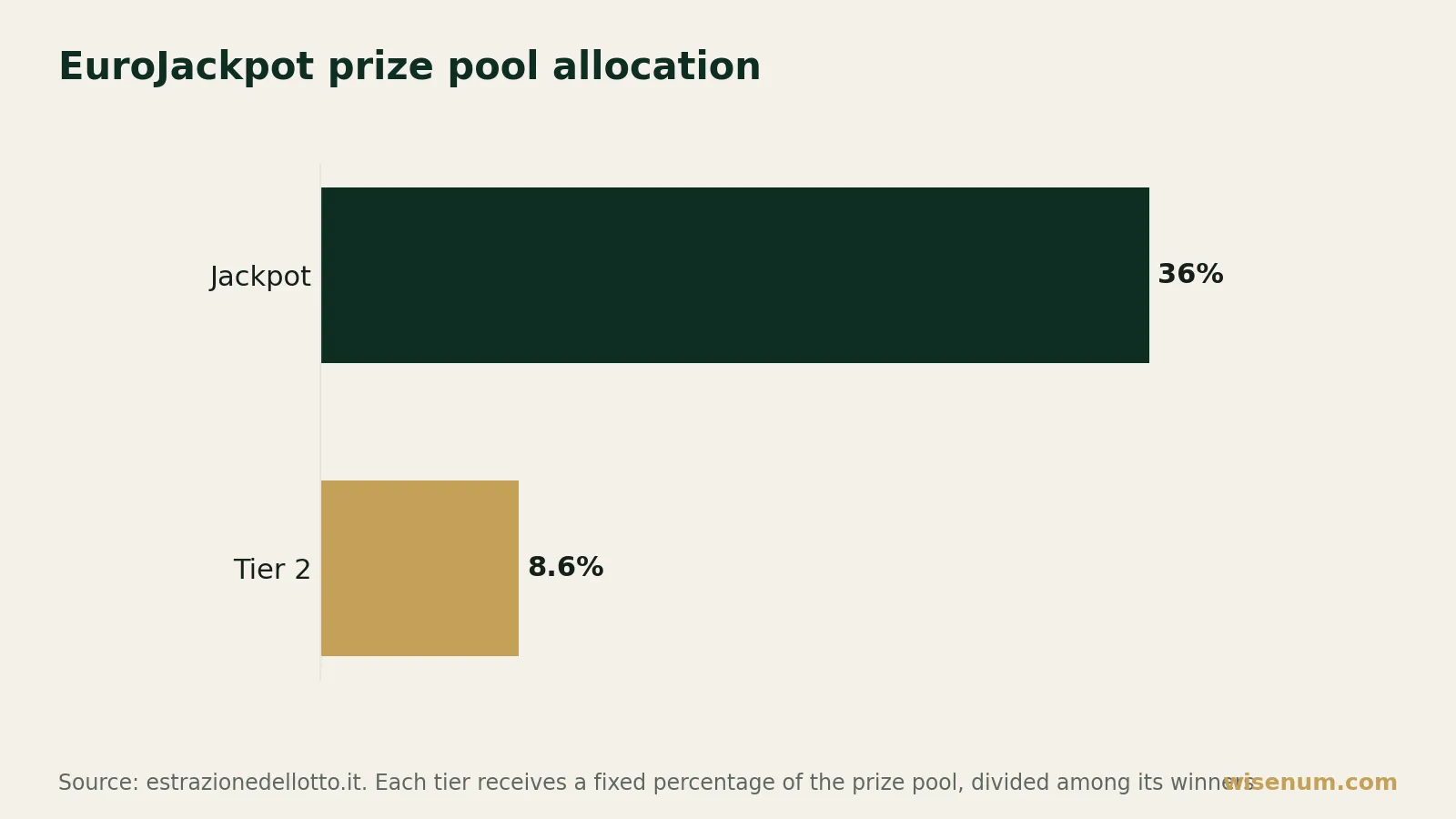
- EuroJackpot: 12 tiers. The jackpot receives 36% of the fund, the Match 5 + 1 Euro Number tier 8.6%, the Match 5 + 0 tier 4.85%, and so on down to the Match 2 + 1 tier, which receives 20.3% (prize fund distribution).
The calculation is simple. If a tier receives a share P of the fund, each winner gets P divided by the number of winners. With 1 winner, they receive P; with 2, P ÷ 2; with 4, P ÷ 4. The percentages are set in advance, but the number of winners changes with every draw, so the prize for the same tier varies from one draw to the next. In the US, outside California, the same tier generally pays the same amount every draw.
What this means for the amount you receive
The consequence is as follows:
- Powerball and Mega Millions (outside California): a line's popularity matters for the jackpot only. The more a combination is played, the more likely it is to be shared if it wins. The lower tiers do not move.
- California: it matters at every tier, since everything is parimutuel.
- EuroMillions and EuroJackpot: it matters at every tier, not just the jackpot.
Wisenum estimates this popularity from the numbers of winners published at each tier: 1,404 Powerball draws, from October 7, 2015 to September 19, 2026, and 930 Mega Millions draws since October 31, 2017 (source: Wisenum Powerball popularity model, 2026, and Wisenum Mega Millions popularity model, 2026; the method is detailed on the Methodology pages for Powerball and Mega Millions). For Europe, the models rely on winner counts across Europe; see the Methodology pages for EuroMillions and EuroJackpot.
One important point: every combination has the same probability. The odds of each tier are on the Powerball, Mega Millions, EuroMillions and EuroJackpot pages. What varies is what you receive if you win. For the jackpot, see the probability of sharing a big jackpot and how players choose their numbers; for how to keep your favorite numbers while playing a less-shared line, the article Avoid a Shared Jackpot goes into it.
The takeaway
- Powerball and Mega Millions: only the jackpot is shared. The lower tiers are fixed amounts, with a reduction clause if the prize pool is not enough.
- California: every tier is parimutuel, so the amount depends on the number of winners.
- EuroMillions and EuroJackpot: each tier receives a fixed share of the prize fund, divided among its winners. The same tier can therefore pay a different amount at each draw.
- A line's popularity matters for the jackpot only in the US, but for every tier in Europe. It affects only the amount you receive.
Playing EuroMillions, where a line's popularity matters at every tier? See whether your line looks like the most common picks and discover less-shared versions: Analyze a line
Play for fun, and only spend what you can afford to lose. Responsible gambling support: in the US, call 1-800-GAMBLER (ncpgambling.org); in the UK, visit BeGambleAware.
Frequently asked questions
Why is Powerball's Match 5 worth $1 million outside California?
In the US, the lower tiers of Powerball and Mega Millions are fixed amounts announced in advance. Powerball's Match 5 pays $1 million whether there is 1 winner or 10, except in California, where everything is parimutuel and the amount depends on sales and on the number of winners.
In EuroMillions, why does the same tier pay a different amount at each draw?
In EuroMillions, each tier receives a fixed percentage of the total prize fund (for example, 2.61% for Match 5 + 1 Lucky Star). That amount is then divided among all the winners of the tier. With more winners, each receives less. The percentage does not change, but the final amount varies with the number of winners.
Does a line's popularity change the amount received at the secondary tiers?
In the US (Powerball and Mega Millions, outside California), popularity matters for the jackpot only. The lower tiers are fixed amounts, unless the reduction clause applies. In Europe (EuroMillions and EuroJackpot) and in California, it matters at every tier, because all of them are parimutuel: the more winners, the less each one receives.
What is Powerball's reduction clause?
If the Powerball prize pool is not enough to cover the payouts, the highest fixed tiers (starting with Match 5) switch to parimutuel one after another. It is a fallback rule, not the usual way the game works.
Every valid combination has the same probability of being drawn. Wisenum does not predict winning numbers.
Sources
- Powerball Prize Chart — Official Powerball website
- California Powerball Prizes: Why They Can Be Bigger Than Other States — KTLA News
- Mega Millions Prize Chart and Odds — Official Mega Millions website
- Mega Millions Official Game Rules — Effective April 5, 2025 (PDF)
- EuroMillions Prizes & Prize Fund Distribution
- EuroJackpot Prize Fund Distribution
- Powerball Draw Result — Saturday, October 3, 2026
- Powerball Set Prize Structure and Pari-Mutuel Rules — D.C. Municipal Regulations § 30-909
- Image : File:Tambiolo (cropped from "Drag Queen Bingo").jpg (CC BY 2.0, Wikimedia Commons)