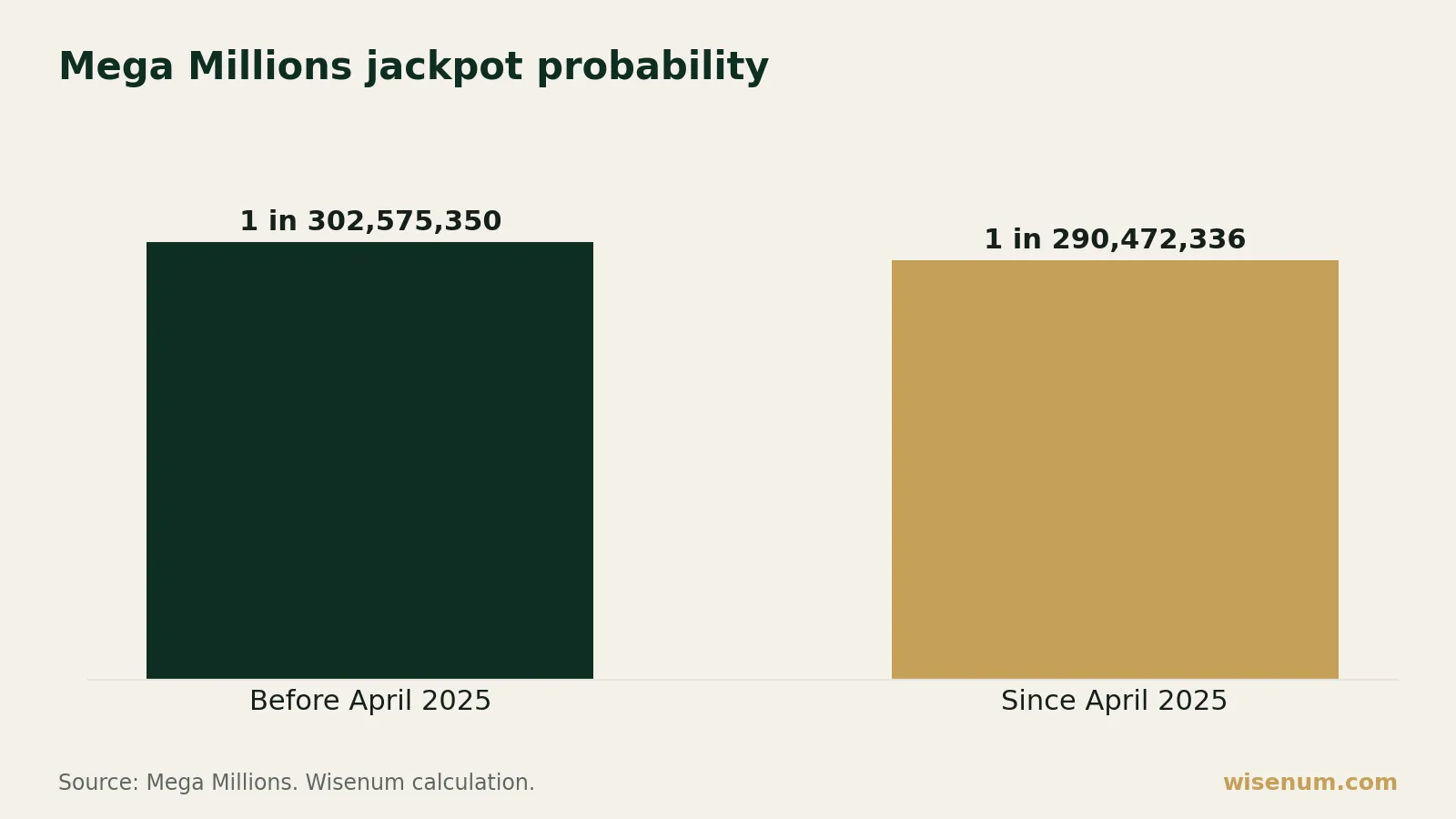
Since April 2025, the Mega Millions jackpot probability went from 1 in 302,575,350 to 1 in 290,472,336. The calculation, step by step.
Since April 8, 2025, a Mega Millions ticket costs $5 instead of $2. At the same time, the Mega Ball pool went from 25 balls to 24, and the jackpot probability moved from 1 in 302,575,350 to 1 in 290,472,336. That is a change of about 4%, and it has nothing to do with the price: one fewer ball explains all of it.
From $2 to $5: the price increase
The first drawing under the new format took place on Tuesday, April 8, 2025, at 11 p.m. Eastern Time. The last drawing of the old format was on Friday, April 4, 2025, and sales of the new tickets began on Saturday, April 5, 2025 (Mega Millions).
The price of a line goes from $2 to $5, which is $3 more and a 150% increase (3 ÷ 2 = 1.5). According to the sources consulted, it is the first increase since 2017 and only the second since the game launched in 2002 (Mega-Millions.com).
Drawing days and time are unchanged: Tuesday and Friday at 11 p.m. Eastern Time, from Georgia.
The Mega Ball pool lost one ball
A Mega Millions line is made of two separate draws:
- 5 white numbers out of 70, a rule that has not changed;
- 1 Mega Ball, drawn from 25 numbers until April 4, 2025, and from 24 since April 8, 2025.
The 5 white numbers did not move. The whole difference in jackpot probability therefore comes from the second pool (MyLottoStats).
How the jackpot probability is calculated
To win the jackpot, two independent events must both happen: matching the 5 white numbers, and matching the Mega Ball. So the two probabilities are combined, which amounts to multiplying the numbers of possible combinations.
The 5 white numbers. Order does not matter: we count the groups of 5 numbers out of 70:
- 70 × 69 × 68 × 67 × 66 = 1,452,361,680
- divide by 5 × 4 × 3 × 2 × 1 = 120
- 1,452,361,680 ÷ 120 = 12,103,014 combinations
The Mega Ball.
- Before: 25 possibilities. 12,103,014 × 25 = 302,575,350, or 1 in 302,575,350.
- Since April 8, 2025: 24 possibilities. 12,103,014 × 24 = 290,472,336, or 1 in 290,472,336.
Both results match the official probabilities published by Mega Millions (press release).
To picture it: with two drawings a week, or 104 drawings a year, a line played at every drawing would take on average 290,472,336 ÷ 104, or about 2.8 million years, to hit the jackpot.
Does this 4% change really matter?
Each group of 5 white numbers can now be paired with one fewer Mega Ball. Removing one ball out of 25 therefore shrinks the total number of combinations:
- 302,575,350 − 290,472,336 = 12,103,014, and 12,103,014 ÷ 302,575,350 = 0.04: 4.0% fewer combinations;
- seen the other way around, the probability is multiplied by 25 ÷ 24 = 1.0417, which is 4.17% higher.
Both readings describe the same change. But the order of magnitude stays the same: we go from a probability of around 1 in 300 million to one of around 1 in 290 million. For comparison, the 5 white numbers alone are 1 in 12,103,014, and it is this unchanged part that weighs the most.
If we look at the probability of winning any prize, the sources give 1 in 23.99 before and 1 in 23.07 after, about 3.8% lower on the denominator (MyLottoStats). The change is real, but modest.
The built-in multiplier: the real change for secondary prizes
The $5 price does not change the probabilities: it pays for an automatic multiplier added to every ticket (Mega-Millions.com).
- The old Megaplier, a $1 option, is gone, and so is the "Just the Jackpot" option.
- The new 2×, 3×, 4×, 5× or 10× multiplier applies to all non-jackpot prizes.
- The minimum prize goes from $2 to $10 ($5 × 2).
- 5 white numbers without the Mega Ball: $1,000,000 before ($2,000,000 with the Megaplier), from $2,000,000 to $10,000,000 now.
- The Mega Ball alone: $2 before, from $10 to $50 now.
The starting jackpot goes from $20 million to $50 million. These amounts and their breakdown come from the sources cited; they may change, so check the current rules on the official site.
To see the calculation method applied to another game, read how lottery odds are calculated, using EuroMillions as the example.
The takeaway
- The price goes from $2 to $5, and the jackpot probability from 1 in 302,575,350 to 1 in 290,472,336. This 4% change comes only from the Mega Ball, which went from 25 balls to 24.
- Every line has the same probability of being drawn. The drawing stays random, and nobody knows in advance which numbers will come up.
- What a player can control is not the probability of winning, but the risk of sharing the prize: a line that few players have picked reduces that risk, whatever the number of balls in the pool.
Try a line to see how many players may have picked the same numbers: your first check is free, no account needed. Try Wisenum
Play for fun, and only spend what you can afford to lose. Responsible gambling support: in the US, call 1-800-GAMBLER (ncpgambling.org); in the UK, visit BeGambleAware.
Frequently asked questions
Why did the Mega Millions jackpot probability change in 2025?
Since April 8, 2025, the Mega Ball pool has gone from 25 balls to 24, while the 5 white numbers are unchanged. The number of possible combinations drops by about 4%, so the jackpot probability moves from 1 in 302,575,350 to 1 in 290,472,336.
Does the $5 price change the probability of winning?
No. The price went from $2 to $5 (a 150% increase), but only the Mega Ball, with one fewer ball, explains the 4% shift. The higher price pays for an automatic multiplier on non-jackpot prizes.
Does a 4% change really matter?
Not much. The change is real, but the order of magnitude stays the same: from around 1 in 300 million to around 1 in 290 million. The 5 white numbers alone are 1 in 12,103,014, and that part did not change.
What is the biggest change for players in the new format?
The built-in multiplier: every ticket now plays with an automatic 2×, 3×, 4×, 5× or 10× multiplier on non-jackpot prizes. The old $1 Megaplier is gone, and the minimum prize goes from $2 to $10.
Can a player reduce the risk of sharing a Mega Millions prize?
Every line has the same probability, and no method changes the probability of winning. What a player can control is the risk of sharing the prize: choosing a line that few players have picked reduces that risk.
Every valid combination has the same probability of being drawn. Wisenum does not predict winning numbers.