After 19 rollovers, the Mega Millions jackpot reached $321M: why that raises the risk of sharing the prize, but not the odds of winning.
The Mega Millions rollovers jackpot story continues: the October 2, 2026 draw produced no jackpot winner. According to the results published by the New York Lottery, it is the 19th consecutive rollover, with an estimated jackpot of $321 million (annuity value). The next draw will therefore be the 20th in the series.
This long streak without a winner changes one thing and leaves another untouched. The probability of winning stays exactly the same. The risk of having to share the jackpot goes up.
19 draws without a winner: what it really means
A rollover is a draw in which nobody matched the winning combination. The jackpot is then carried over to the next draw and added to the prize pool. It is a carry-over mechanism, nothing more.
A Mega Millions draw has no memory. The balls don't "know" that the previous 19 draws had no winner. Each draw is independent of the others, and 19 rollovers do nothing to raise the probability for the 20th draw.
This is the classic trap of the gambler's fallacy: believing that a streak without a winner brings the next result closer. We explain how it works in our article on the gambler's fallacy and "due" numbers. A line doesn't become more or less likely because the jackpot has grown.
The odds haven't changed, but sales have
According to the official Mega Millions website, the probability of winning the jackpot is 1 in 290,472,336. It depends neither on the number of rollovers nor on the amount accumulated.
To get a feel for that scale, here is a simple calculation:
- a year has 365 × 24 × 3,600 = 31,536,000 seconds;
- 290,472,336 ÷ 31,536,000 ≈ 9.2;
- matching the winning line is therefore like guessing the exact second out of about 9.2 years.
What does move is the number of players. Economic research has shown this for a long time. A study by Hudja (2013) on Mega Millions data from 1995 to 2012 finds a positive and statistically significant relationship between jackpot size and ticket sales. For each additional million dollars in the jackpot, the sales growth rate rises by 0.12 percentage points. The same work documents a threshold effect around $100 million.
A more recent study, published in 2024 using Toronto data, points the same way. In every model tested, jackpot size is positively associated with sales, with a large effect.
At $321 million, we are well above the $100 million threshold. It is reasonable to assume that more lines are played than at a modest jackpot. The sources don't give the number of lines sold for this draw, and we won't make one up.
The risk of sharing rises with the jackpot
The more lines are played, the more likely it is that several of them win at the same time. A jackpot split between several winners pays each of them less.
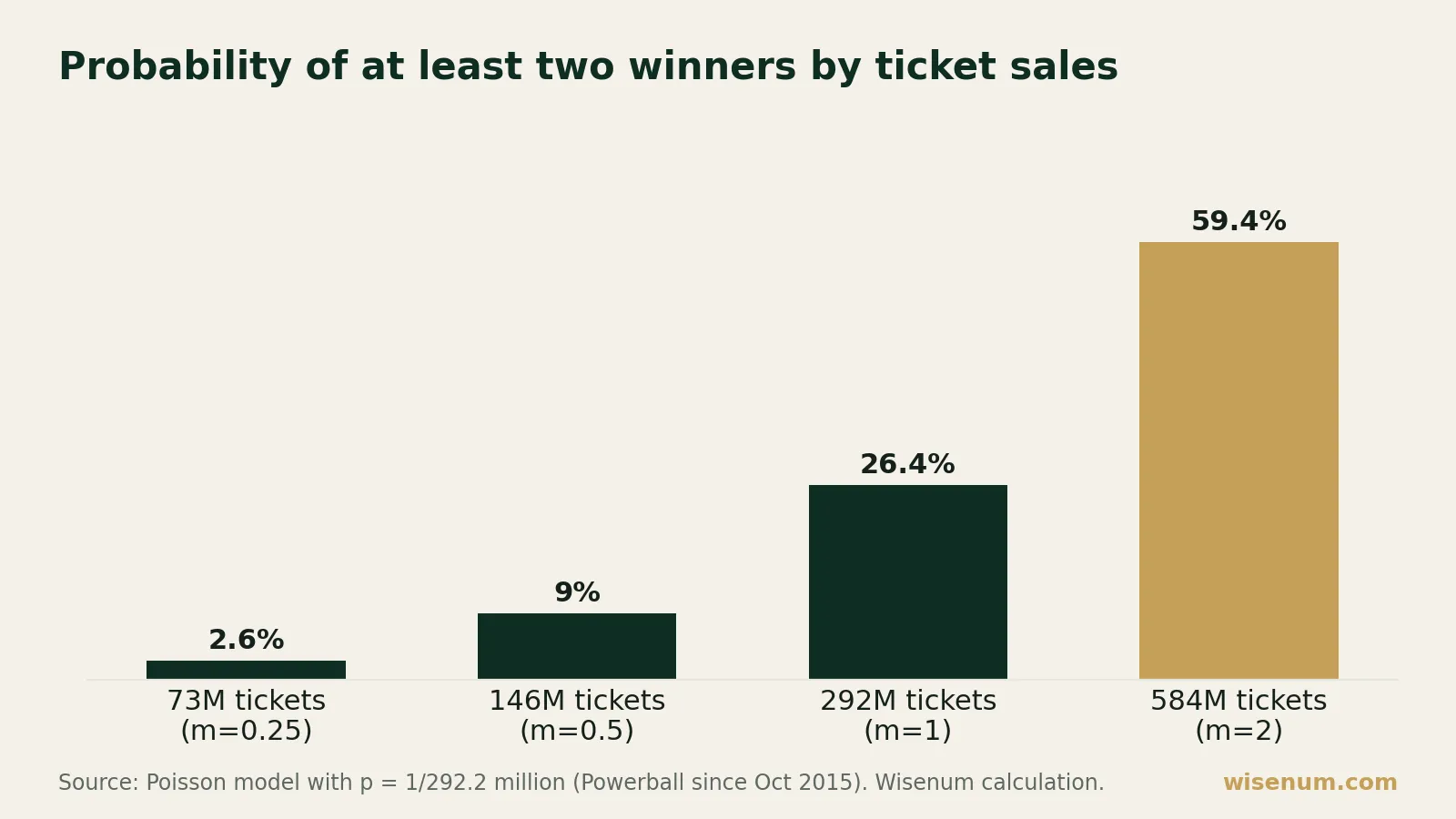
The calculation is simple. If N lines are played at random, the expected number of winners is m = N ÷ 290,472,336. Assuming each line is independent, the probability of at least two winners, given that there is at least one, comes from the Poisson distribution: [1 − e^(−m) − m × e^(−m)] ÷ [1 − e^(−m)].
Here are three hypothetical volumes, chosen only to illustrate the mechanism (these are not real sales figures):
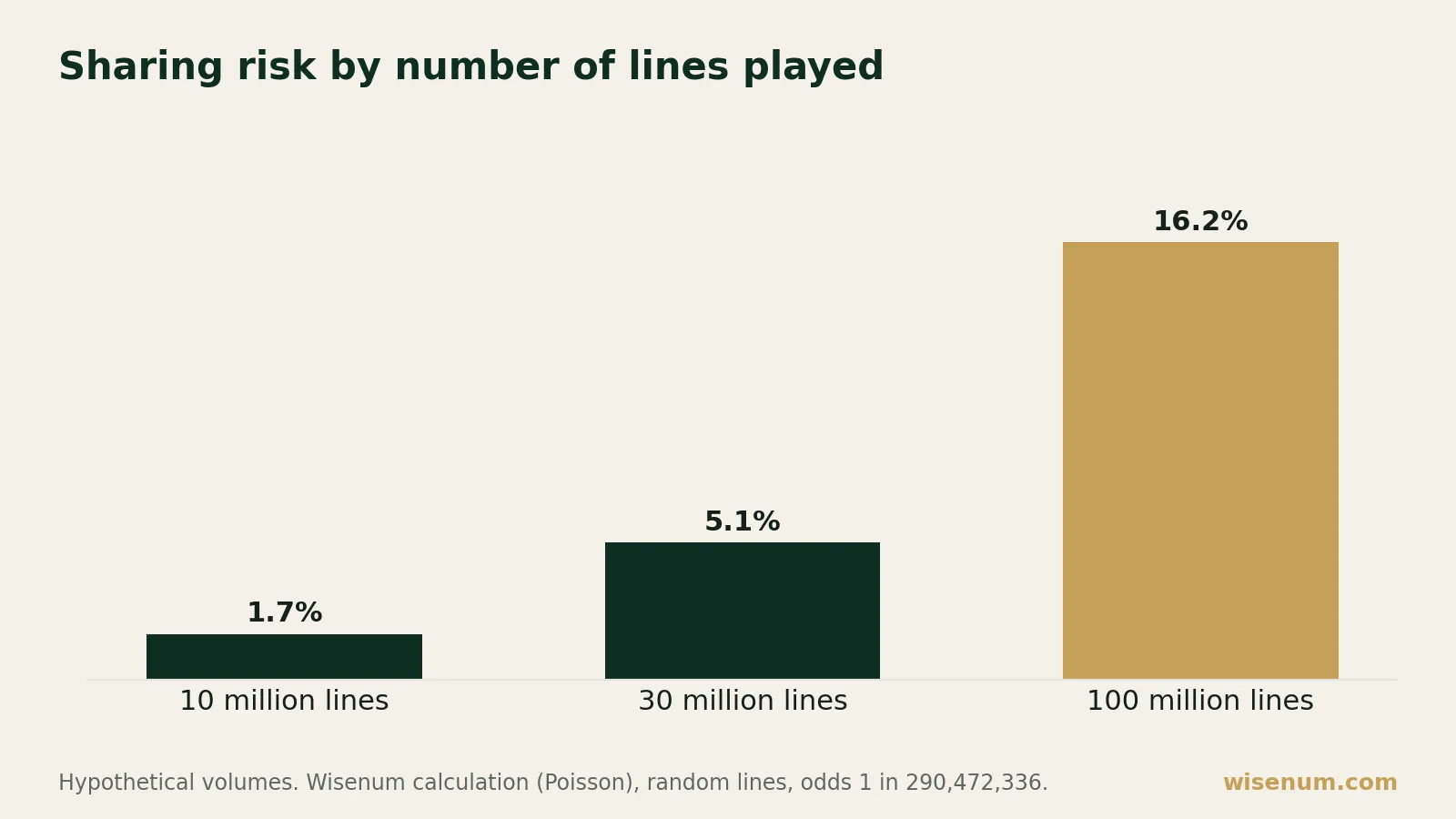
- 10 million lines: m ≈ 0.034. Probability of at least one winner: 3.4%. If there is one, the probability that they are not alone is about 1.7%.
- 30 million lines: m ≈ 0.103. Probability of at least one winner: 9.8%. Probability of sharing, given that there is a winner: about 5.1%.
- 100 million lines: m ≈ 0.344. Probability of at least one winner: 29.1%. Probability of sharing, given that there is a winner: about 16.2%.
The reading is clear: when the number of lines goes from 10 million to 100 million, the probability of sharing, given that there is a winner, goes from about 1.7% to 16.2%, nearly ten times higher. This model assumes randomly chosen lines. In reality, many players pick dates or lucky numbers, which concentrates lines and makes sharing even more likely. We cover this in the article Avoid a Shared Jackpot.
Be careful not to draw the opposite conclusion: this risk doesn't make a win more or less likely. It only concerns the amount each winner would split, if there are any.
The Takeaway
- After 19 rollovers, the jackpot probability is still 1 in 290,472,336. Each draw is independent.
- A big jackpot attracts more players. Research links jackpot size to higher sales, with a threshold effect around $100 million.
- More lines played means a higher risk of sharing, not a higher probability of winning.
- The only lever left is how you pick your numbers: a less popular line is less exposed to sharing, without changing the probability of winning.
Playing the next draw? See whether your line looks like the most common picks: Analyze a line
Play for fun, and only spend what you can afford to lose. Responsible gambling support: in the US, call 1-800-GAMBLER (ncpgambling.org); in the UK, visit BeGambleAware.
Frequently asked questions
After 19 rollovers, has the probability of winning the Mega Millions jackpot gone up?
No. Each draw is independent. The probability stays exactly 1 in 290,472,336, no matter how many rollovers came before. The 19 rollovers don't bring the next result any closer.
Why does a big jackpot raise the risk of sharing?
Studies link a high jackpot to higher ticket sales. The more lines are played, the more likely it is that several of them win the jackpot in the same draw. This sharing risk only concerns the amount each winner receives, not the probability of winning.
How many lines were sold for this Mega Millions draw?
Official sources don't publish the exact number of lines sold per draw. We used hypothetical volumes to show how the Poisson calculation estimates the risk of sharing.
How can I reduce the risk of having to share my jackpot?
By choosing less popular numbers. Many players pick dates or easy-to-remember sequences, which concentrates lines. An unusual line is less exposed to sharing, without changing your probability of winning.
Every valid combination has the same probability of being drawn. Wisenum does not predict winning numbers.