The latest big EuroMillions jackpot, €130M, was won on September 25, 2026 by a ticket bought in the UK. See what it shows about odds and sharing.
On Friday, September 25, 2026, a player who bought their ticket in the UK won the €130 million EuroMillions jackpot outright. It is the latest big EuroMillions jackpot for which our sources confirm both the amount and the country. Here is what we know, what we don't, and what this win teaches us about odds and prize sharing.
The September 25 draw: the figures
Here is what the published results for draw No. 1984 on September 25, 2026 confirm:
- Date: Friday, September 25, 2026.
- Amount: €130,000,000.
- Country of the winning ticket: United Kingdom.
- Number of top-tier winners: one, who therefore received the entire jackpot.
- Entries recorded: 37,786,361.
The other tiers were paid too: €361,615 per winning ticket for "5 numbers + 1 Lucky Star", and €31,693 per winning ticket for "5 numbers" alone.
What we don't know is the winner's identity. As far as we are aware, no public claim has been announced, and we offer no guesses about it.
One note on dates: according to Wisenum data, the October 2, 2026 draw also had a single top-tier winner (5 numbers + 2 Lucky Stars). Its amount and the country of the ticket are not in our sources, so we do not quote them. The September 25 draw remains the latest big jackpot for which both details are confirmed.
A Superdraw: a jackpot set at €130 million
The September 25 draw was a Superdraw, a special draw whose jackpot is announced in advance at €130 million, rather than depending only on the rollover from previous draws.
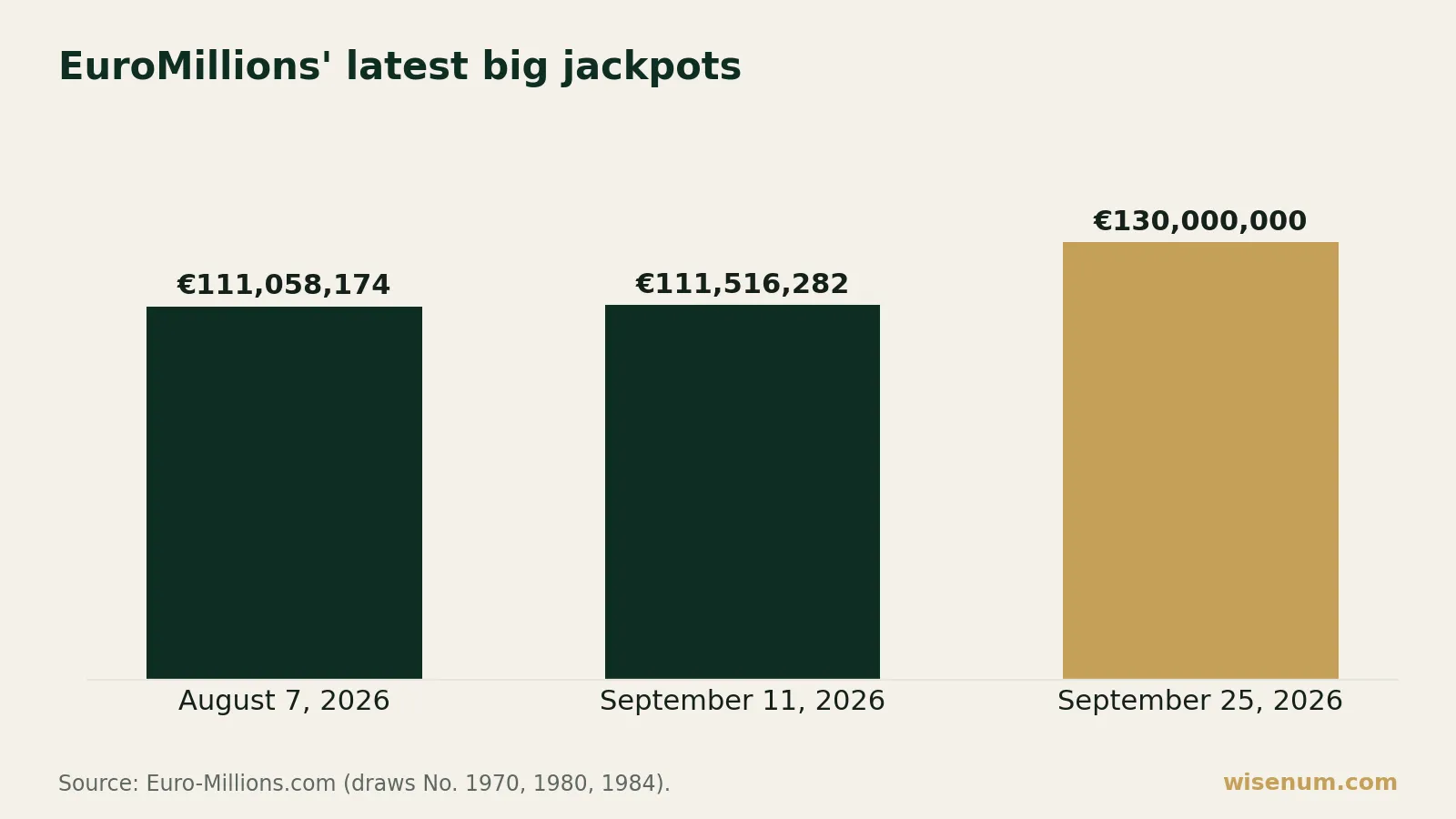
To put that amount in context, here are the two previous jackpots recorded in our sources:
- September 11, 2026: €111,516,282, won in Austria;
- August 7, 2026: €111,058,174, won in Belgium.
The September 25 jackpot exceeds the September 11 one by €18,483,718 (130,000,000 − 111,516,282), or about 16.6% more.
Between the two, the September 11 win brought the jackpot back down to its starting level, and the prize pot then grew again. The draw numbers (1980 for September 11, 1984 for September 25) show that three draws took place in between: Nos. 1981, 1982 and 1983.
The real odds of the jackpot
To win the EuroMillions jackpot, you need to match the 5 numbers and the 2 Lucky Stars. The probability is exactly 1 in 139,838,160. You will find the full breakdown in our article on how EuroMillions odds work.
A concrete picture: at one line per second, without a break, it would take 139,838,160 seconds to play them all. That is 139,838,160 ÷ 86,400 ≈ 1,618.5 days, or about 4.4 years.
A €130 million jackpot changes nothing about this probability. It is the same for every line, whatever the amount at stake.
A second calculation helps explain why a draw can end with no winner. With 37,786,361 entries for 139,838,160 possible combinations, we get 37,786,361 ÷ 139,838,160 ≈ 0.27. If every entry were independent of the others and chosen at random, we would expect 0.27 jackpot winners on average. The probability that at least one entry wins would then be, according to the Poisson distribution, 1 − e^(−0.27) ≈ 0.24, or about 24%, roughly one in four. This is a simplification: in reality, players do not choose their lines at random. But the order of magnitude shows that having no winner is the most common outcome, and that is how jackpots build up.
What this teaches us about prize sharing
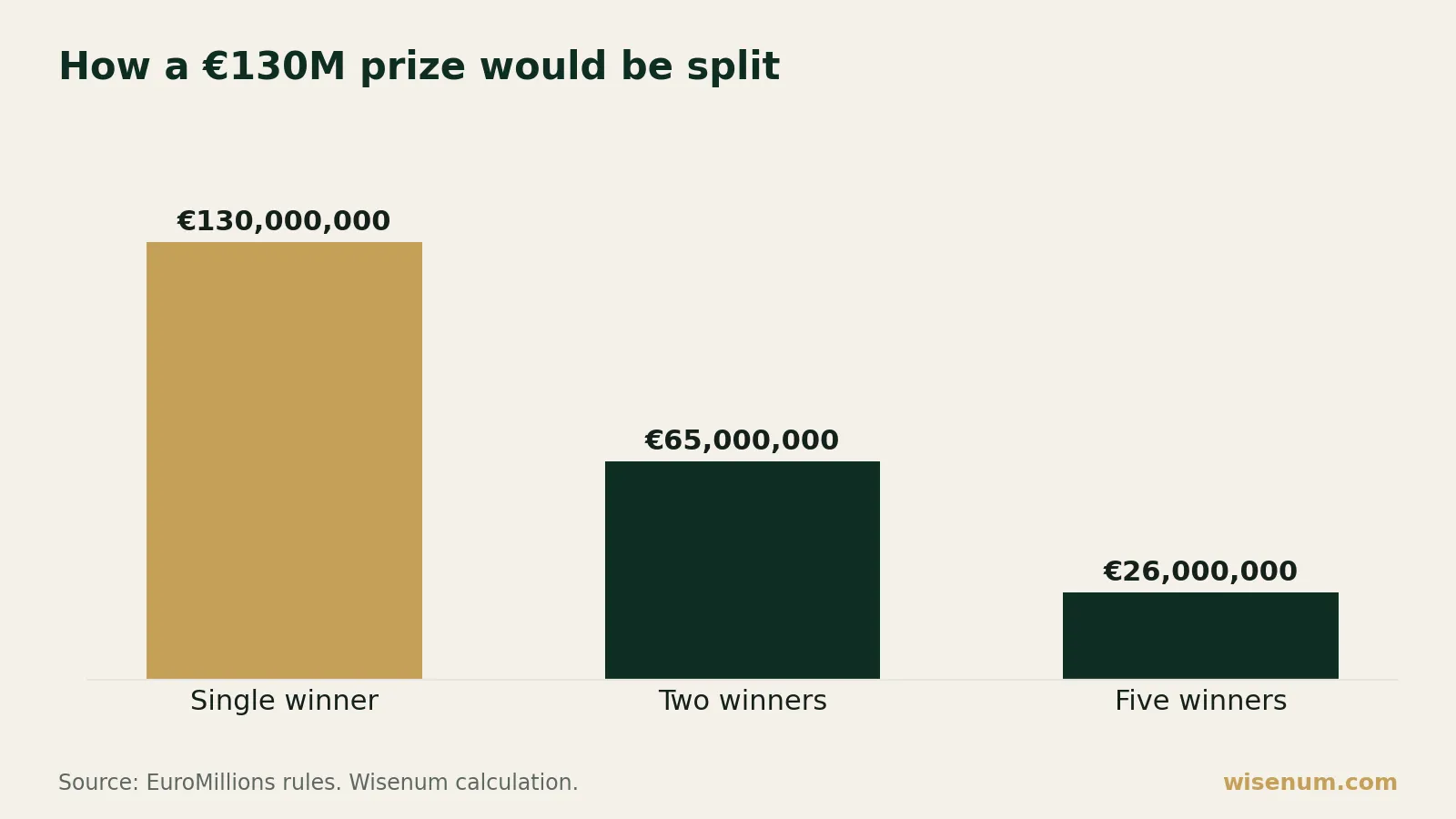
Here, a single ticket had the right combination. The winner therefore received the full €130 million.
If two players had matched the same combination, the jackpot would have been split: 130,000,000 ÷ 2 = €65,000,000 each. With five winners, €26,000,000 each.
All combinations have the same probability of being drawn. What varies from one line to another is the number of players who picked it. Birthdays, for example, concentrate lines on the lower numbers (why birthdays concentrate lines). A very popular combination has the same probability of coming up as any other, but if it does, it exposes you to a likelier split.
That is what Wisenum measures: the popularity of combinations, and so the risk of sharing a win. It does not change the probability of winning, only the share you would keep if you did win.
The takeaway
- On September 25, 2026, a single ticket, bought in the UK, won the €130 million EuroMillions Superdraw. The winner's identity is not known.
- The probability of winning the jackpot is 1 in 139,838,160 for every line, whatever the announced amount.
- A big jackpot does not make a win more likely. The only thing that varies from one line to another is the risk of having to share the jackpot with other winners.
Playing the next draw? See whether your line looks like the most common picks: Analyze a line.
Play for fun, and only spend what you can afford to lose. Responsible gambling support: in the US, call 1-800-GAMBLER (ncpgambling.org); in the UK, visit BeGambleAware.
Frequently asked questions
How much was the EuroMillions jackpot on September 25, 2026?
The EuroMillions jackpot on September 25, 2026 was €130 million. It was a Superdraw, a special draw whose jackpot is announced in advance, rather than depending only on the rollover from previous draws. A single ticket, bought in the UK, won the entire jackpot.
What are the real odds of winning the EuroMillions jackpot?
The probability of winning the EuroMillions jackpot is exactly 1 in 139,838,160. It is the same for every line, whatever the announced amount. A bigger jackpot never makes a win more likely.
Why did the September 25 winner receive the full €130 million?
Because they were the only winner with the right combination. If several players had matched the same numbers, the jackpot would have been split between them. That is why popular combinations (such as those built on birthdays) expose you to a likelier split.
What do we know about the winner?
The winner of the September 25, 2026 Superdraw bought their ticket in the UK. As far as we are aware, their identity has not been made public and no public claim has been announced. We do not speculate about who they are.
Every valid combination has the same probability of being drawn. Wisenum does not predict winning numbers.