Powerball in California paid $2,259,918 for Match 5 on October 10, 2026, versus $1M in Arizona. Pari-mutuel vs. fixed prizes explained.
On October 10, 2026, Powerball in California paid $2,259,918 to a ticket that matched the 5 white numbers without the Powerball, according to the California Lottery. On October 3, 2026, the same prize level paid $1,000,000 to a winner in Arizona, according to the official Powerball results. The $1.26 million gap comes from California's pari-mutuel system: most states pay a fixed amount for this level, while California splits a prize pool whose size depends on ticket sales and the number of winners.
A $2.26 Million Secondary Prize: How Is That Possible?
Matching the 5 white numbers without the Powerball is the second prize level in the game. It is a secondary prize: it does not depend on the jackpot, and its amount is listed in the Powerball prize chart.
The gap between the two winners is simple arithmetic:
- $2,259,918 − $1,000,000 = $1,259,918 more in California;
- 2,259,918 / 1,000,000 ≈ 2.26: the California prize was about 2.26 times the fixed prize.
This level is rare. The probability of matching the 5 white numbers without the Powerball is 1 in 11,688,053.52, or about 1 in 11.7 million (source: Powerball prize chart). You will find the odds for every prize level on the Powerball odds page.
California's Pari-Mutuel System
In a pari-mutuel system, the winners at a given level share a prize pool. The amount is therefore not known in advance. The California Lottery says so on its game page: in California, Powerball prizes are pari-mutuel, vary with ticket sales and the number of winners, and differ from the fixed amounts shown on the Powerball website.
For a given level, the logic is simple:
- the bigger the pool for that level, the more each winner receives;
- the more winners there are at that level, the smaller each share.
On October 10, 2026, there was only one second-level winner in California, so the prize was not shared with anyone. The sources we consulted do not publish the size of the pool that night. We therefore cannot break down how the $2,259,918 figure was reached, only what makes it vary.
California does not offer the Power Play option on its Powerball tickets. Its secondary prizes therefore work entirely on this sharing principle.
Fixed Prizes in Other States
In most other states, the second prize level in Powerball pays a fixed $1,000,000. It does not matter how many winners there are or how many tickets were sold that night: the amount is announced in advance. That is what happened on October 3, 2026, in Arizona, where a single ticket matched this level.
With the Power Play option ($1 extra per ticket), this level becomes $2,000,000, double the base amount. For the second level, it is the only multiplier: it is 2X and does not change from one draw to the next (source: Powerball prize chart).
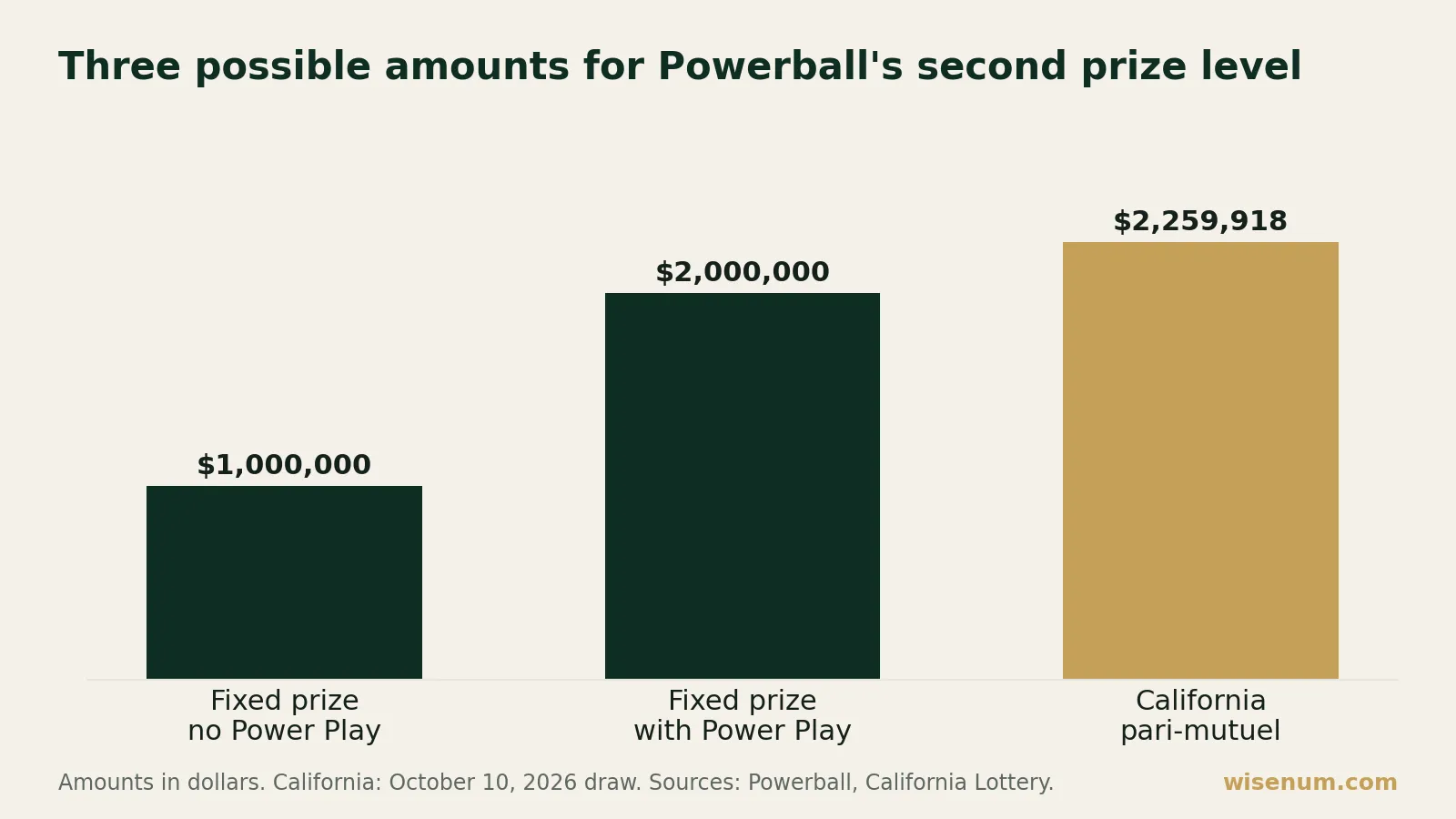
That gives three possible amounts for the same prize level:
- $1,000,000 in a fixed-prize state, without Power Play;
- $2,000,000 in a fixed-prize state, with Power Play;
- a variable amount in California, which was $2,259,918 on October 10, 2026.
In the first two cases, you know what you would receive before the draw. In the third, you find out afterward. Our article on secondary prizes shared or fixed compares four games; this one takes a close look at the California case.
Pari-Mutuel and Line Popularity
One principle holds for any shared pool: the more winners there are, the less each one receives. The second-level winners are those who matched the same 5 white numbers, so the popularity of a line matters. A line that many players choose, for example because it follows birthdays, is more likely to end up shared with others when a prize is won.
This changes nothing about the probability of being drawn. Every combination has the same one: 1 in 11,688,053.52 for this level. Only the share that remains after a win is affected. Wisenum estimates the popularity of combinations for Powerball; the method is described on the Powerball methodology page. The details of this draw are on the October 10, 2026 results page.
The Takeaway
On October 10, 2026, the second prize level in Powerball paid $2,259,918 in California against $1,000,000 in Arizona on October 3, because California shares a prize pool instead of paying a fixed amount. That amount depends on ticket sales and the number of winners, so it can be higher or lower than $1,000,000. The probability of the level is the same everywhere: 1 in 11,688,053.52. Only the sharing of a possible prize varies.
Playing the next draw? See whether your line looks like the most common picks to discover less-shared versions: Analyze a line
Play for fun, and only spend what you can afford to lose. Responsible gambling support: in the US, call 1-800-GAMBLER (ncpgambling.org); in the UK, visit BeGambleAware.
Frequently asked questions
Why does Powerball pay a different amount in California than elsewhere?
California uses a pari-mutuel system: the winners at a given level share a prize pool, and the amount depends on ticket sales and the number of winners. Most other states pay a fixed amount that is known in advance. For the second level (5 white numbers), that is $1,000,000 in fixed-prize states without Power Play, and a variable amount in California.
How does California's pari-mutuel system work out the prize?
Two factors matter: the bigger the pool for the level, the more each winner receives; the more winners there are, the smaller each share. On October 10, 2026, a single winner matched the second level in California and received $2,259,918.
Why does line popularity matter for the second prize level?
It does not change the probability of being drawn: every Powerball combination has the same one (1 in 11,688,053.52 for the second level). It only affects sharing: a heavily played combination is more likely to be shared with other winners when a prize is won. Wisenum estimates this popularity to spot less-shared lines.
What is the Power Play option and how does it affect the second prize level?
Power Play is a paid option ($1 extra per ticket) available in most fixed-prize states. For the second level, it doubles the prize: $1,000,000 becomes $2,000,000. It is the only multiplier for this level and it does not change from one draw to the next. California does not offer this option.
Can the same Powerball prize level pay three different amounts?
Yes, for the second level: $1,000,000 in a fixed-prize state without Power Play, $2,000,000 with Power Play, and a variable amount in California ($2,259,918 on October 10, 2026). Our article on secondary prizes compares four games.
Every valid combination has the same probability of being drawn. Wisenum does not predict winning numbers.