Powerball jackpot on October 3, 2026: $440M annuity, $181.3M cash option. See the tax impact and how jackpot size changes the risk of sharing a prize.
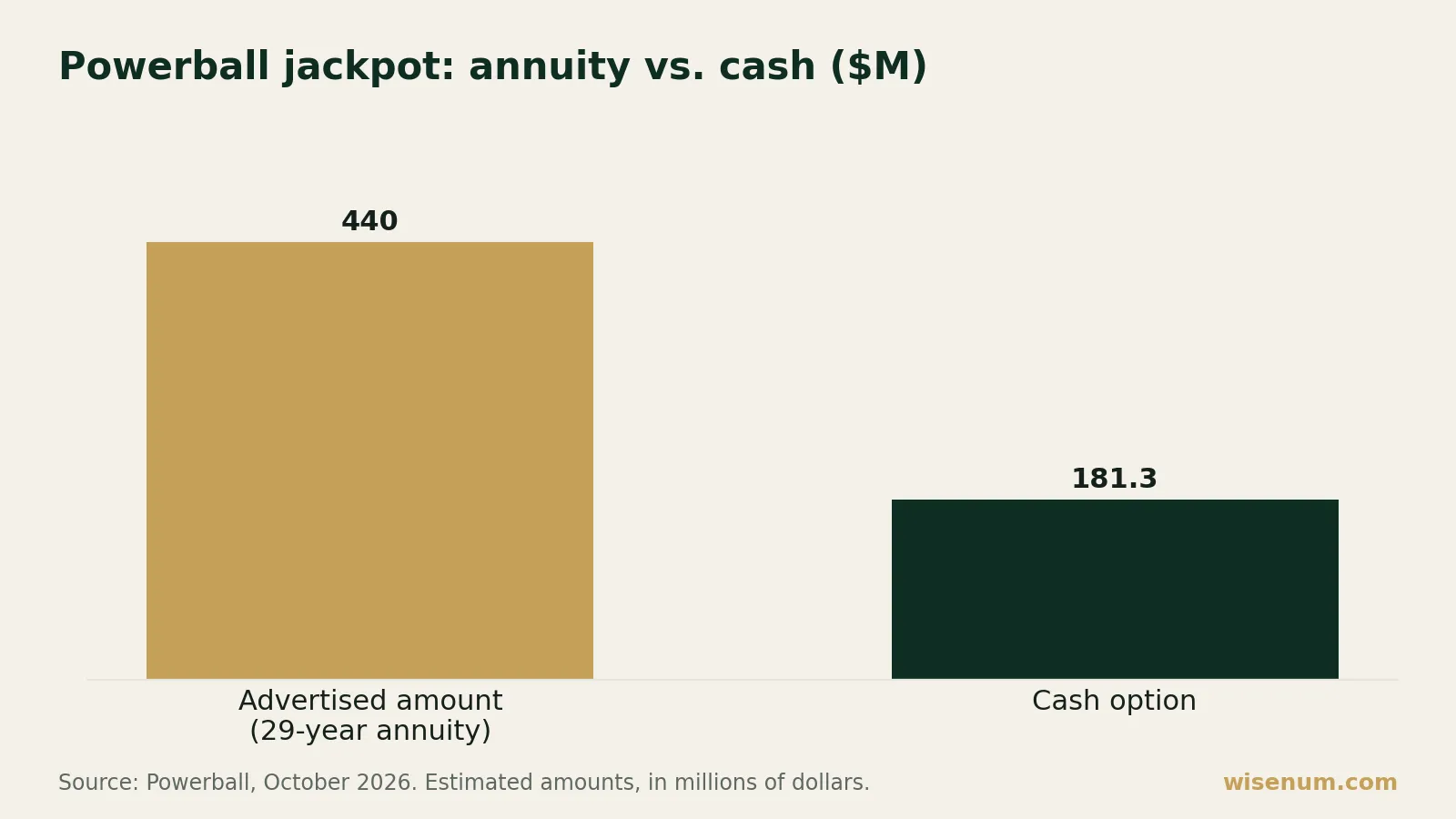
The Powerball jackpot stood at $440 million for the draw on Saturday, October 3, 2026, according to the US press. But that figure is an annuity paid over 29 years. The cash option was $181.3 million, or 41.2% of the advertised total. Here is where the gap comes from, what is left after taxes, and what the size of the jackpot really changes for you.
All amounts in this article are estimates published by Powerball and relayed by the press. They can change from one draw to the next.
Advertised jackpot vs. cash option: where the difference comes from
The amount Powerball puts forward is an annuity: 30 annual payments spread over 29 years, each 5% larger than the one before (MarketWatch). The cash option pays out, in one go, the sum actually set aside for this jackpot.
The calculation is simple:
- Cash: $181.3M ÷ $440M = 41.2% of the advertised amount.
- Gap: 440 − 181.3 = $258.7M that is not paid out if the winner takes the cash.
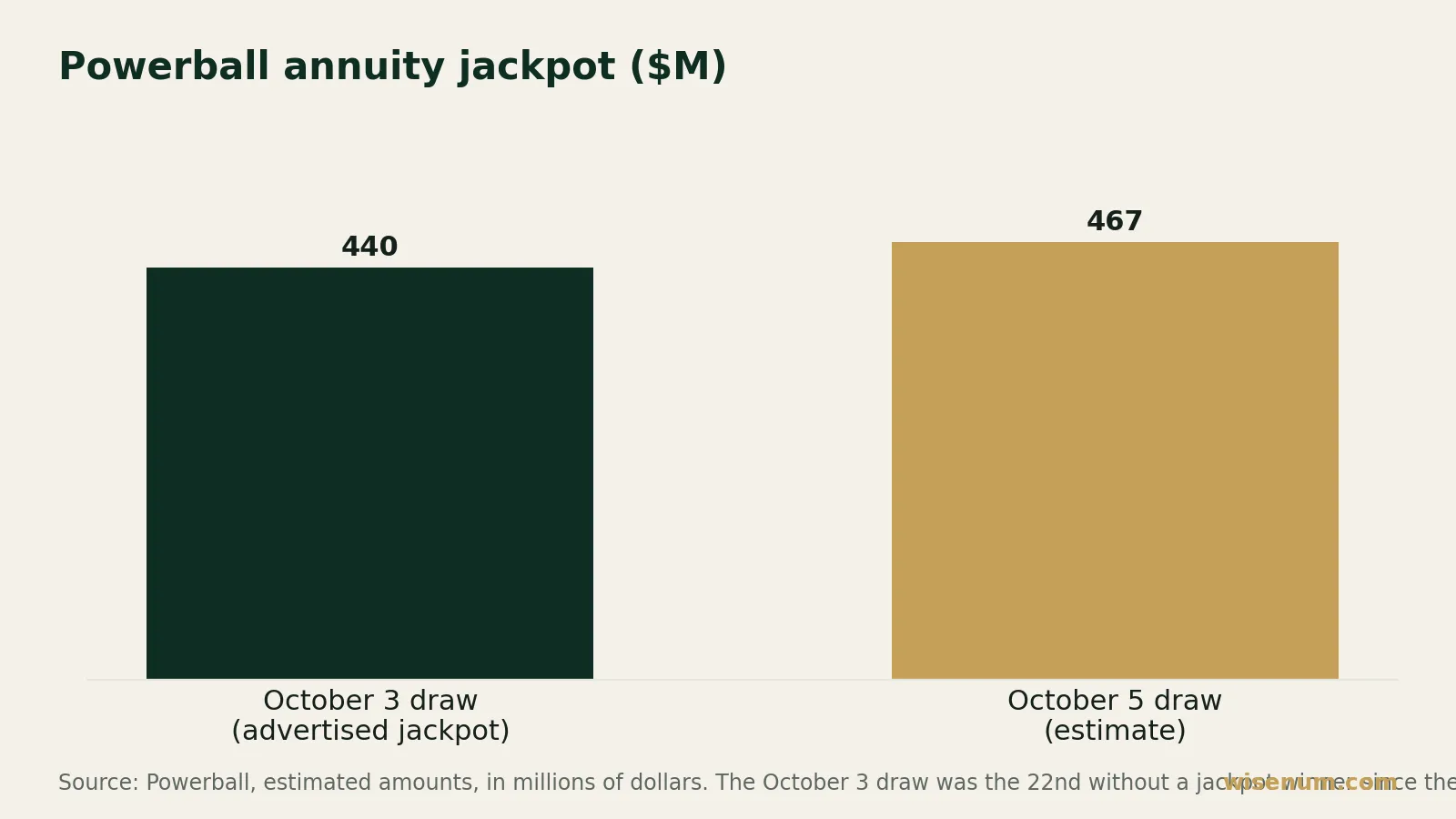
- For the next draw (Monday, October 5, 2026), Powerball estimates a $467M annuity and $192.4M in cash, which is also 41.2% (powerball.com).
The gap depends on the return assumed on the money invested over 29 years: the higher interest rates go, the wider the gap between annuity and cash.
If we assume the $440M is the sum of the 30 payments, with a 5% increase each year, the first payment would be about $6.6M and the last about $27.3M. This is an order of magnitude calculated here, not an official figure.
Federal taxes: what the IRS takes
In the United States, 24% is withheld at source, whether the winner chooses the annuity or the cash (CNBC). On $181.3M:
- 24% withholding: 181.3 × 0.24 = $43.5M.
- What is left: 181.3 − 43.5 = $137.8M, before state taxes and the final tax settlement.
The top federal marginal rate is 37%. If that rate were applied to the whole sum (an upper bound for federal tax, since the tax is progressive), you would get 181.3 × 0.37 = $67.1M, leaving about $114.2M. State taxes range from 0% to more than 8%, depending on where the ticket was bought and where the winner lives.
This calculation is meant to give an order of magnitude. It is not tax advice.
30-payment annuity or immediate cash
The difference in taxation comes down to timing. The cash option concentrates the tax in a single year. The annuity spreads it over 30 annual payments.
For comparison, the winner of the $1.04 billion jackpot, won in Illinois on August 12, 2026, chose the cash option: $450.5M (Public Gaming). That is 43.3% of the advertised amount (450.5 ÷ 1,040).
Rollover history since August 2026
After that August 12 win, the jackpot was reset to its starting level for the August 15 draw. Between August 15 and September 30, 2026, 21 draws went by without a jackpot winner, which is what a rollover is. The October 3 draw was the 22nd of that run. The October 5 jackpot is estimated at $467M, which shows there was no winner on October 3: the increase is $27M (467 − 440).
A jackpot that keeps building does not change the probability of winning from one draw to the next. Each draw is independent of the ones before it.
How jackpot size affects the risk of sharing
The probability of winning the Powerball jackpot is 1 in 292,201,338 (powerball.com). To picture that number: flipping heads 28 times in a row is 1 in 268,435,456, so slightly more likely. This probability stays the same whether the jackpot is modest or at $440M. It depends on neither the amount, nor the number of rollovers, nor the line you pick.
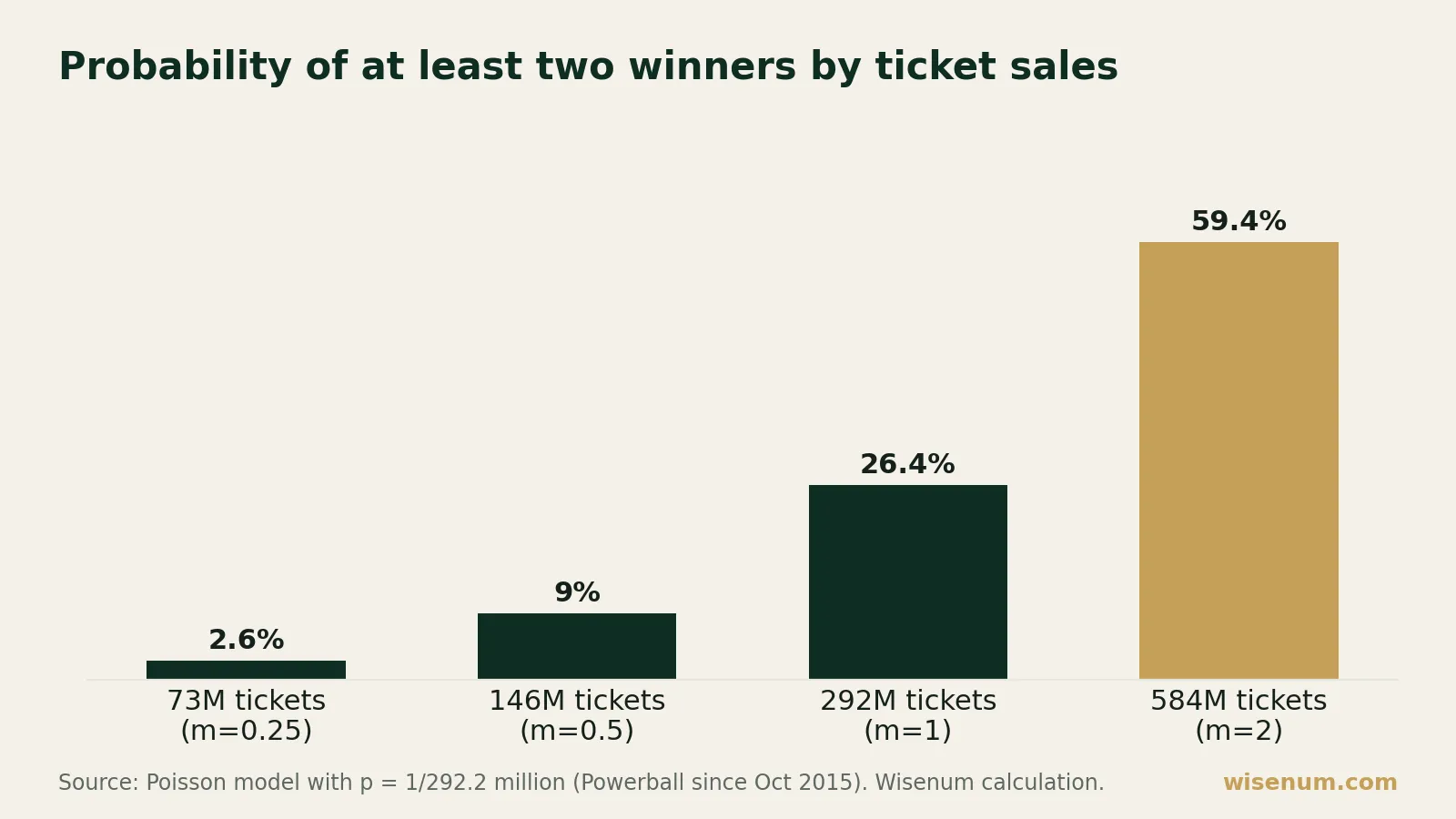
What changes with a big jackpot is the attention it attracts. If more lines are played, it becomes more likely that several winners split the jackpot, and the amount you would receive would be divided accordingly. Wisenum has no access to ticket sales, but it measures something else: the popularity of number combinations.
According to the Wisenum model (validated on 1,404 Powerball draws since October 7, 2015), the popularity ratio of lines over the last 200 draws (since June 23, 2025) is 1.257, with a 95% interval of 1.208 to 1.307. A ratio above 1 means players do not pick their numbers at random: some combinations are played more often than others. This estimate covers the five main numbers, not the Powerball number.
Birth dates are one known cause, as our page on birthday lines explains. Across 1,409 draws analyzed up to September 30, 2026, the Wisenum model puts the popularity ratio at about 1.73 between a line whose five main numbers are all calendar numbers and a line containing none (95% interval: 1.64 to 1.83). This is not a way to win: every combination has the same probability. It is an indicator of the risk of sharing a prize.
To understand how a jackpot probability is calculated, you can read our article on the EuroMillions jackpot probability.
The takeaway
The $440M jackpot is an annuity amount. The cash option, $181.3M, is 41.2% of it, and about $137.8M remains after the 24% federal withholding and before other taxes. The probability of winning is the same as at every draw: 1 in 292,201,338. What the size of the jackpot changes is the number of players, and so the risk of having to share the prize.
Playing the next draw? See whether your line looks like the most common picks: Analyze a line
Play for fun, and only spend what you can afford to lose. Responsible gambling support: in the US, call 1-800-GAMBLER (ncpgambling.org); in the UK, visit BeGambleAware.
Frequently asked questions
Why is the $440 million Powerball jackpot only worth $181.3 million in cash?
The advertised amount ($440M) is an annuity: 30 annual payments spread over 29 years, each 5% larger than the one before. The cash option pays out, in one go, the sum actually set aside, which is 41.2% of the advertised amount (181.3 ÷ 440). The higher interest rates go, the wider the gap between annuity and cash.
How much is left after federal taxes on $181.3 million?
Federal tax first withholds 24%, or $43.5M, leaving $137.8M. Applying the top federal marginal rate (37%) to the whole sum, an upper bound since the tax is progressive, the tax would be about $67M, leaving about $114M. State taxes come on top, from 0% to more than 8% depending on the state. This is not tax advice.
Does the size of the jackpot change the probability of winning?
No. The probability of winning the Powerball jackpot is 1 in 292,201,338, whatever the size of the jackpot. What changes with a big jackpot is the number of players, and so the likelihood of having to share the prize with other winners.
Was the Powerball jackpot won on October 3, 2026?
Powerball estimates the jackpot for Monday, October 5, 2026 at $467M, up from $440M for the October 3 draw: the $27M increase shows it was not won on October 3. These amounts are estimates.
What is a rollover in Powerball?
A rollover happens when no player wins the jackpot in a draw. The jackpot then carries over to the next draw. Between August 15 and September 30, 2026, 21 draws went by without a jackpot winner; the October 3 draw, at $440M, was the 22nd of that run.
Every valid combination has the same probability of being drawn. Wisenum does not predict winning numbers.
Sources
- Powerball jumps to $440 million. Saturday, Oct. 3, results, numbers
- Powerball Home — Next Drawing & Recent Results
- $1.040 billion Powerball jackpot won in Illinois
- If you hit the $750 million Powerball jackpot, here's your tax bill
- Lump sum or annuity? Experts weigh in on Powerball jackpot cash out options
- How Do Lottery Payments Work? Annuity vs. Cash Payouts
- Powerball winning numbers for Oct. 3: $440M jackpot
- Illinois Lottery: $1.04 billion Powerball jackpot-winning ticket sold in Quincy, IL