How to avoid a shared jackpot: an unpopular line can reduce the risk of sharing a prize, but it never changes the probability of winning: 1 in 139,838,160.
In EuroMillions, every line has exactly the same probability of winning the jackpot: 1 in 139,838,160. Choosing uncommon numbers does not change that figure. It can, however, reduce the risk of sharing the jackpot with other winners. If you want to avoid a shared jackpot, here is what works, what doesn't, and why.
Three truths about shared jackpots
1. All combinations are equal. EuroMillions has 139,838,160 possible combinations. The calculation is simple: 5 numbers out of 50 give 2,118,760 possibilities, 2 Lucky Stars out of 12 give 66, and 2,118,760 × 66 = 139,838,160. The line 1-2-3-4-5 with Lucky Stars 1-2 has the same probability as any other (source). To picture it: if you played one combination per second, it would take you about 4.4 years to go through them all (139,838,160 ÷ 31,557,600 seconds in a 365.25-day year). The full calculation is in our article on where this probability comes from.
2. The draw is random. No method, no draw history and no software changes this probability. Nobody knows in advance which numbers will come up.
3. Sharing happens after the draw, not before. Your line wins or it doesn't, regardless of what other players pick. But if it does win, the amount you receive depends on the number of winners.
How a prize is shared
EuroMillions works on a parimutuel basis: each prize tier receives a share of the prize fund, and that share is split equally among all the winners in the tier (the Irish operator's rules, prize tier details).
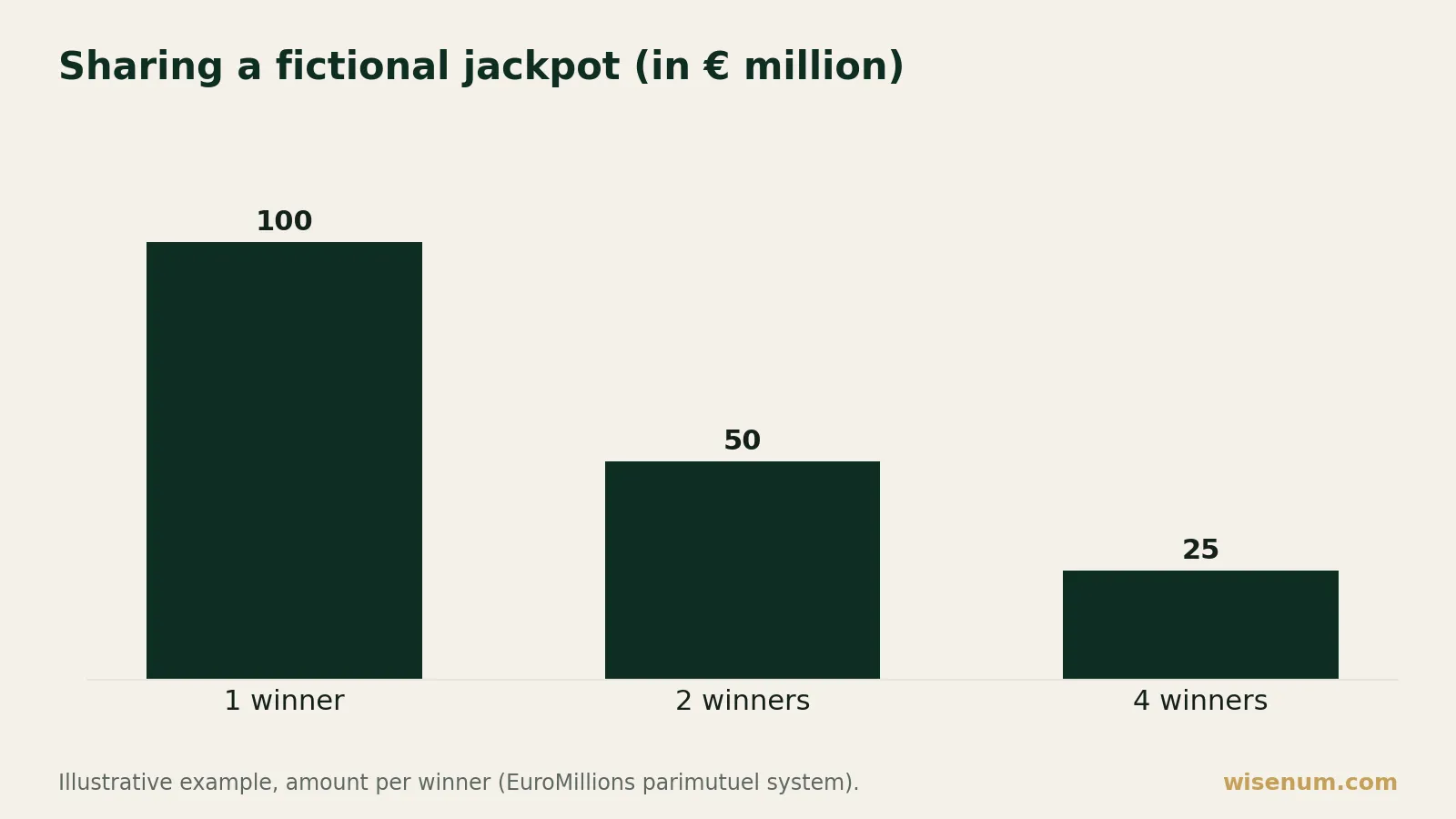
An illustrative example, with a fictional jackpot of €100 million:
- one winner: €100 million;
- two winners: €50 million each;
- four winners: €25 million each.
The mechanism applies to lower tiers too. Sharing is not a quirk of the jackpot: it is the rule for every EuroMillions prize.
Why popular lines exist
Players don't pick their numbers at random. Many choose birthdays, which concentrates picks on the numbers 1 to 31. Others play runs of consecutive numbers or long-time favourites (Wisenum, "How it works"). We explain this effect in why birthday numbers concentrate lines.
As a result, some lines are played far more often than others. If one of them comes up, it is more likely to have several winners, and so a divided prize. The draw itself is nothing special: it is player behaviour that is skewed.
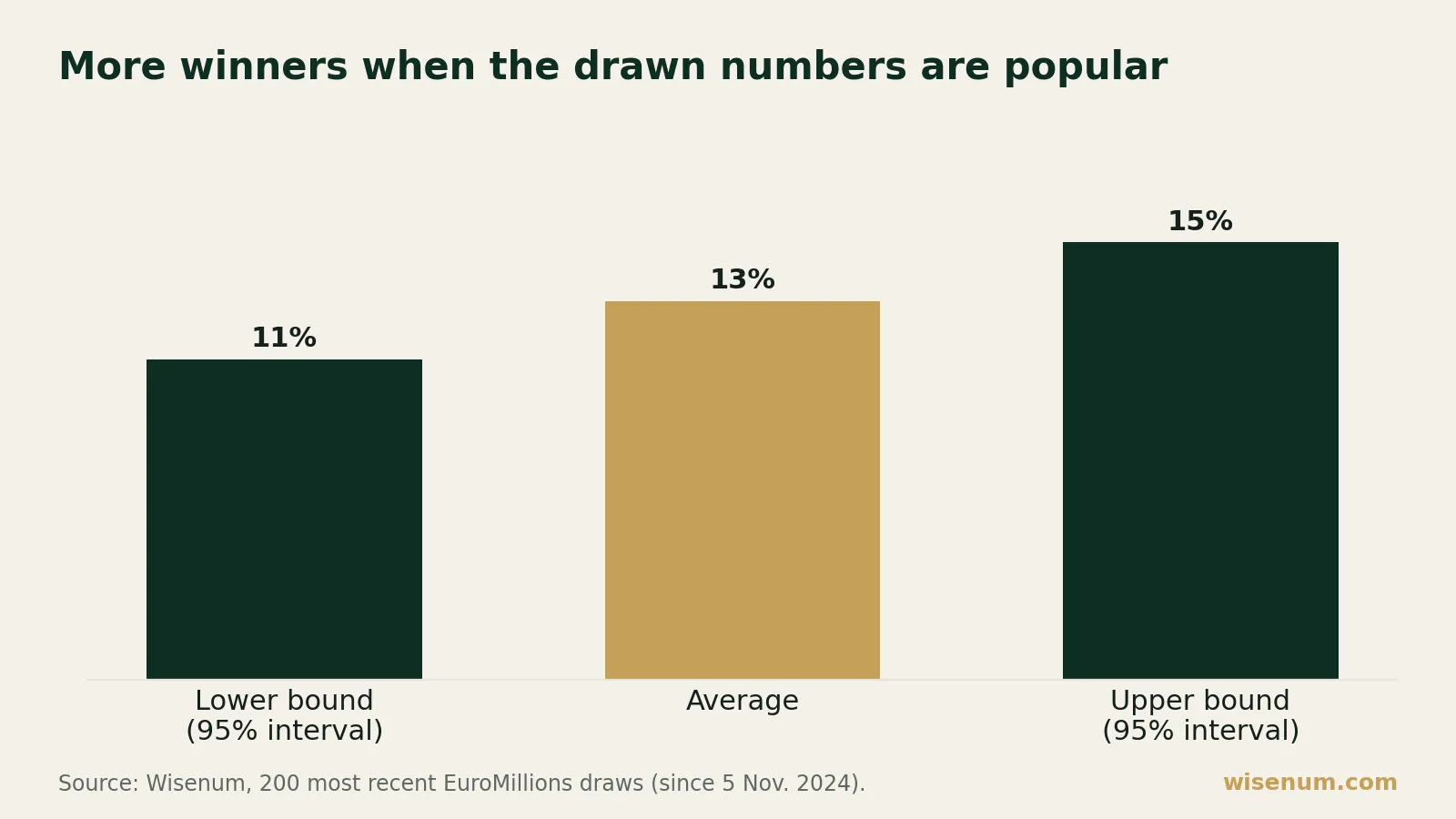
Wisenum measured this effect on EuroMillions results. Over the last 200 draws (since 5 November 2024), when the drawn numbers were among those Wisenum rates as most played, there were on average 13% more winners, for equal participation (95% interval: 11% to 15%, comparing the 50 draws rated most played with the 50 rated least played) (Wisenum methodology). This is an average over 200 draws: it says nothing about the next one.
How Wisenum's popularity levels work
Wisenum estimates how popular a line is from official historical results: it measures how closely the line resembles players' common choices. This measure says nothing about the next draw, and it does not affect the probability of 1 in 139,838,160.
With the "Analyze a line" feature, you see where yours stands. Wisenum then suggests variants that keep some of your favourite numbers and change others to reduce sharing. These variants are presented as less-shared versions, in levels, from the closest to your line to the least shared. The higher the level, the further the line moves away from common choices, which generally means changing more of your original line (Wisenum, "How it works").
What these levels aim for: a line that looks less like common choices, and so is less likely to be shared if it wins. What they don't bring: a higher probability of winning. It stays the same.
What changes nothing
Several popular ideas don't do what people think they do:
- Playing "recently drawn" numbers, or numbers that haven't come up in a long time. A number that has been absent for a long time is no more likely to come up: the draw has no memory.
- Believing a run like 1-2-3-4-5 is less likely. It has the same probability as every other line. Its only particularity is its popularity, often higher: avoiding it may reduce the risk of sharing, not change the probability of winning.
- Playing more lines to avoid sharing. Each extra line is still exposed to sharing if it wins, and the total stake depends on the number of lines played.
- Believing a "rare" line is more likely to come up. An unpopular line has the same probability as a popular one. It is just chosen less often by others.
The takeaway
- All EuroMillions combinations have the same probability: 1 in 139,838,160.
- Choosing an unpopular line does not change that probability. It can only reduce the risk of sharing a prize with other winners.
- Sharing is a rule of the game: each tier splits its share of the prize fund equally among its winners.
- The levels of Wisenum's less-shared versions measure how closely a line resembles common choices. They say nothing about the upcoming draw.
Playing the next draw? See whether your line looks like the most common picks: Analyze a line.
Play for fun, and only spend what you can afford to lose. Responsible gambling support: in the US, call 1-800-GAMBLER (ncpgambling.org); in the UK, visit BeGambleAware.
Frequently asked questions
Does choosing an unpopular line change the probability of winning?
No. All EuroMillions combinations have the same probability: 1 in 139,838,160. Choosing an unpopular line does not change that probability. It can only reduce the risk of sharing your prize with other winners if your line comes up.
How is a jackpot shared in EuroMillions?
EuroMillions works on a parimutuel basis: each prize tier receives a share of the prize fund, and that share is split equally among all the winners in the tier. If two lines win in the same tier, they split that tier's share in two.
Why are some lines played more than others?
Players don't pick their numbers at random. Many choose birthdays, which concentrates picks on the numbers 1 to 31. Others play consecutive runs or their favourite numbers. As a result, some lines are played far more often.
What do the levels of Wisenum's less-shared versions measure?
The levels of Wisenum's less-shared versions measure how closely a line resembles players' common choices, estimated from historical results. The higher the level, the further the line moves away from common choices, which aims to reduce the risk of sharing if it wins. But these levels say nothing about the upcoming draw and do not change the probability of winning.
Is a number that hasn't been drawn for a long time more likely to come up?
No. A number that has been absent for a long time is no more likely to come up: the draw has no memory. Each draw is independent of the previous ones.
Every valid combination has the same probability of being drawn. Wisenum does not predict winning numbers.