How EuroMillions rules have changed since 2004: Lucky Stars, jackpot caps and odds, from 1 in 76,275,360 to 1 in 139,838,160, with sourced dates.
EuroMillions history rule changes, in short: since its first draw on 13 February 2004, the game has been reshaped several times. The line gained Lucky Stars, the ticket price moved and the jackpot cap was raised. As a result, the probability of winning the jackpot went from 1 in 76,275,360 to 1 in 139,838,160. Here is the history of the game, step by step, with the calculation each time.
Launch in 2004 and the first changes
The first draw takes place on 13 February 2004 in Paris. Only three countries take part: France, Spain and the United Kingdom [1].
On 8 October 2004, six countries join the game: Austria, Belgium, Ireland, Luxembourg, Portugal and Switzerland. There are now nine participating countries [1].
The original line is as follows: 5 numbers out of 50, plus 2 Lucky Stars out of 9. To get the jackpot probability, we count every possible line:
- Combinations of 5 numbers out of 50: C(50,5) = 2,118,760
- Combinations of 2 Lucky Stars out of 9: C(9,2) = 36
- Total: 2,118,760 × 36 = 76,275,360
So one line in 76,275,360 wins the jackpot. To get a sense of scale: at one line per second, it would take about 2.4 years to play them all (76,275,360 ÷ 31,557,600 seconds per year).
Other rules change afterwards:
- 20 January 2006: a rollover limit appears. The jackpot can roll over 11 times at most. After 12 draws with no winner, the amount is redistributed to the next prize tier down. On 3 February 2006, three winners share a €183 million jackpot after 11 rollovers [1].
- 9 February 2007: first Superdraw, with a €100 million prize pot funded by the reserve fund [1].
- 15 June 2007: launch of "EuroMillions Plus" in Ireland, an extra game with a €500,000 prize pot [1].
A second weekly draw and the move to 11 Lucky Stars (2011)
On 10 May 2011, EuroMillions changes its rhythm and its line [1]:
- a second weekly draw, on Tuesday, is added to the Friday one;
- the number of Lucky Stars goes from 9 to 11;
- a 13th prize tier is created, for tickets that match 2 numbers (there were 12 tiers in 2004).
With 11 Lucky Stars, the calculation changes:
- C(11,2) = 55 Lucky Star combinations
- 2,118,760 × 55 = 116,531,800
The jackpot goes from 1 in 76,275,360 to 1 in 116,531,800, that is 116,531,800 ÷ 76,275,360 ≈ 1.53: the jackpot became about 53% harder to win.
The major 2016 overhaul
On 24 September 2016, the game is deeply reworked [1]:
- the number of Lucky Stars goes from 11 to 12;
- the ticket price becomes £2.50/€2.50;
- the minimum jackpot goes from €15 million to €17 million;
- the number of draws before the jackpot at the cap is redistributed goes from 2 to 5;
- the European Millionaire Maker is introduced.
The price had already changed in the United Kingdom on 7 November 2009: the ticket went from £1.50 to £2, at the same time as the arrival of the extra game "Millionaire Raffle". In several euro-zone countries, it cost €2 before 2016 [1].
With 12 Lucky Stars:
- C(12,2) = 66 Lucky Star combinations
- 2,118,760 × 66 = 139,838,160
The ratio to the previous period is 66 ÷ 55 = 1.20: the jackpot became 20% harder to win. This is the current line. For scale: at one line per second, it would take about 4.4 years to play them all (139,838,160 ÷ 31,557,600). The detail of this calculation is explained in our article on how EuroMillions odds are calculated.
How the jackpot cap evolved
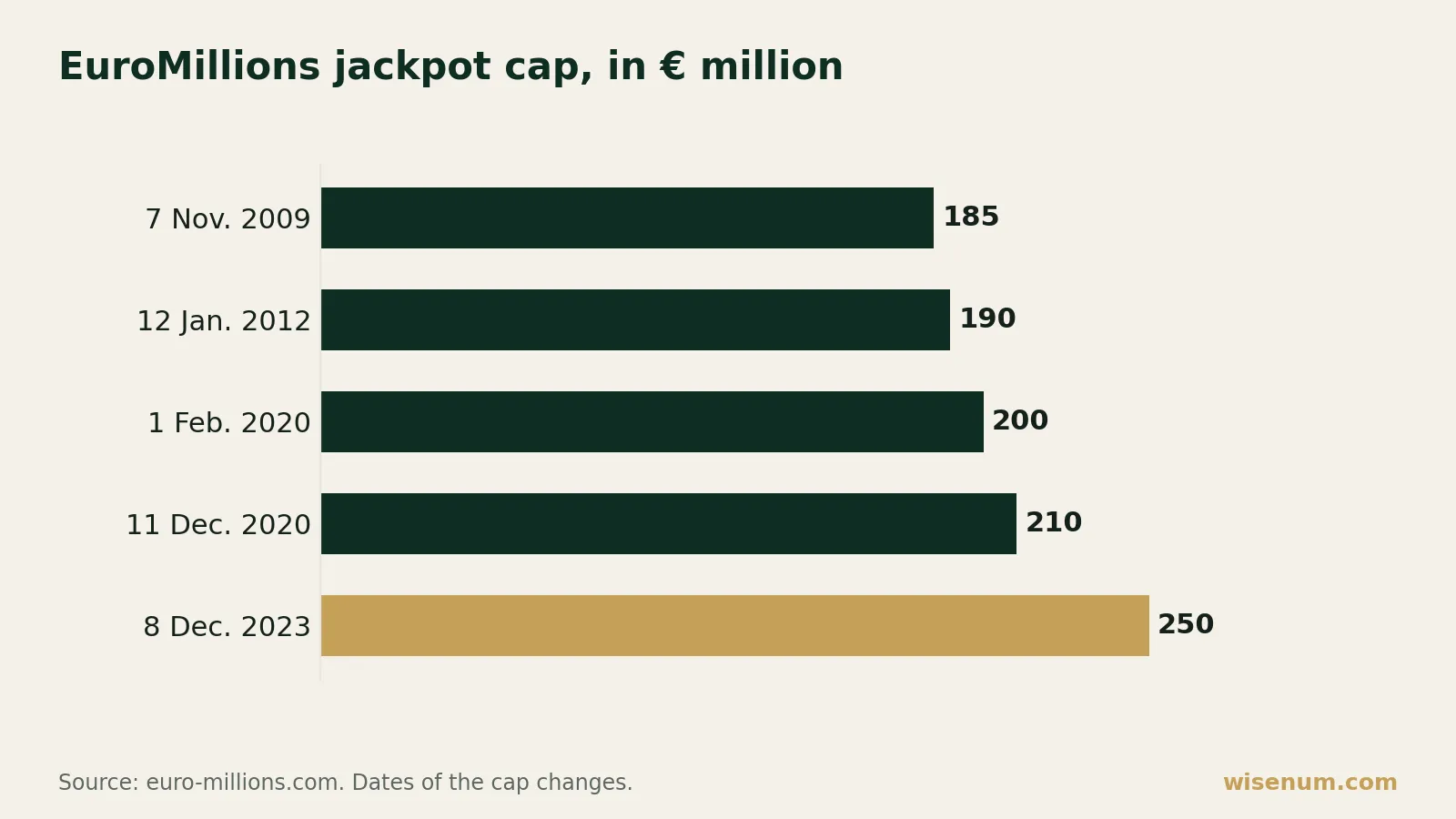
The cap was changed at every major stage. The sources we consulted give the following timeline [1]:
- 2004-2006: no cap. Jackpots roll over without limit.
- 2006-2009: limit of 11 rollovers, then redistribution.
- 7 November 2009: the cap is set at €185 million, with a €5 million rise each time it is reached. It is reached in July 2011 by a Scottish couple, Colin and Chris Weir, who win €185 million (£161.6 million).
- 12 January 2012: the cap is set at €190 million, with no automatic rise. The jackpot can stay there for two draws before redistribution.
- 1 February 2020: the cap goes to €200 million, with a possible rise up to €250 million in steps of €10 million.
- 11 December 2020: after a €200 million jackpot, the cap is raised to €210 million.
- 8 December 2023: according to our source, the maximum cap of €250 million is reached after an Austrian win.
A cap changes nothing about the probability of each line. It only sets the maximum jackpot amount: when it is reached and nobody wins it after a limited number of draws (two in 2012, five from 2016), the sum is redistributed to the lower tiers.
How the odds changed
Only one component of the line has changed: the number of Lucky Stars. The 5 numbers out of 50 have stayed the same, with 2,118,760 combinations.
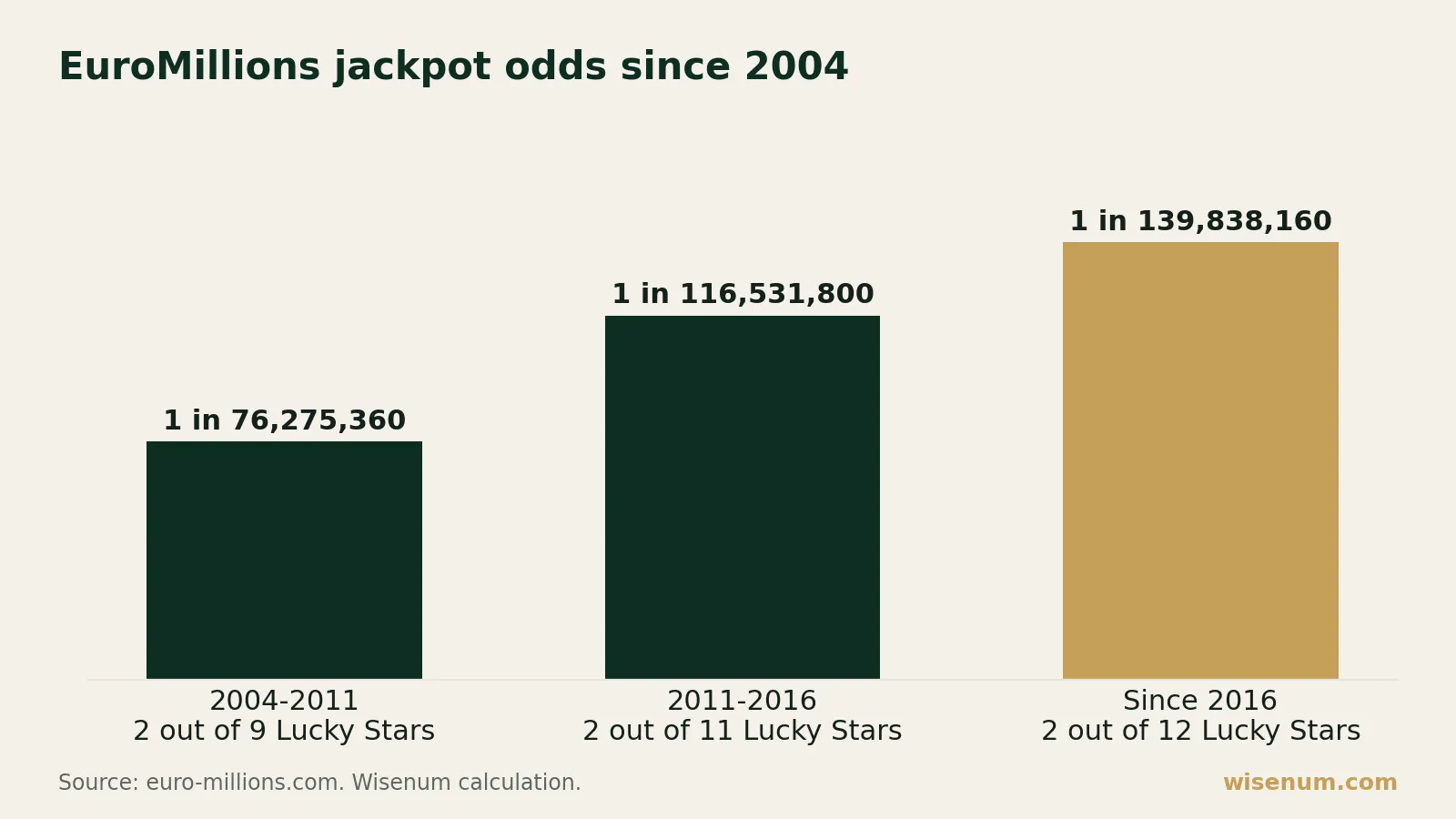
- 2004 to May 2011: 2/9 Lucky Stars, 2,118,760 × 36 = 76,275,360, or 1 in 76.3 million.
- May 2011 to September 2016: 2/11 Lucky Stars, 2,118,760 × 55 = 116,531,800, or 1 in 116.5 million (× 1.53).
- Since September 2016: 2/12 Lucky Stars, 2,118,760 × 66 = 139,838,160, or 1 in 139.8 million (× 1.20).
Each addition of Lucky Stars makes the jackpot rarer. But one thing stays constant: in every era, all lines have exactly the same probability. What varies from one line to another is the number of players who picked it, and therefore the risk of sharing the prize if it wins. A little-played combination is no more likely to be drawn, but it exposes you to less sharing.
The takeaway
- EuroMillions launched on 13 February 2004 with 2 Lucky Stars out of 9: a jackpot at 1 in 76,275,360.
- On 10 May 2011, the move to 11 Lucky Stars put the probability at 1 in 116,531,800.
- On 24 September 2016, the move to 12 Lucky Stars put it at 1 in 139,838,160, still the value in force in the sources we consulted.
- The jackpot cap was set in 2009, then raised several times up to €250 million. It limits the amount, not the probability.
- In every era of the game, each line has the same probability: only the sharing of the prize varies with how popular the combination is.
You can now see where your own line stands compared with the most common picks: Analyze a line.
Play for fun, and only spend what you can afford to lose. Responsible gambling support: in the US, call 1-800-GAMBLER (ncpgambling.org); in the UK, visit BeGambleAware.
Frequently asked questions
When was EuroMillions launched and with what rules?
EuroMillions held its first draw on 13 February 2004, with a line of 5 numbers out of 50 and 2 Lucky Stars out of 9. Only three countries took part at first: France, Spain and the United Kingdom. The jackpot probability was 1 in 76,275,360.
How have the EuroMillions jackpot odds changed?
The jackpot became rarer with each addition of Lucky Stars: 1 in 76.3 million in 2004, then 1 in 116.5 million in May 2011, then 1 in 139.8 million in September 2016. It has stayed the same since.
When did EuroMillions change the number of Lucky Stars?
The number of Lucky Stars went from 9 to 11 on 10 May 2011, then from 11 to 12 on 24 September 2016. Each addition raises the number of possible lines: from 76,275,360 to 116,531,800, then to 139,838,160.
Does the jackpot cap affect the probability of winning?
No, the jackpot cap changes nothing about the probability: it only sets the maximum amount. When it is reached and nobody wins it after a limited number of draws, the sum is redistributed to the lower tiers.
Is any line more likely to win than another?
No, all lines have exactly the same probability in every era of the game. What varies from one line to another is the number of players who picked it: a little-played line exposes you to less sharing.
Every valid combination has the same probability of being drawn. Wisenum does not predict winning numbers.