Was the EuroJackpot draw of October 2, 2026 (04-06-07-17-45) really rare? Its sum is 79, yet its odds were 1 in 139,838,160, like any other line.
The EuroJackpot October 2 2026 rare draw: that is how the result was described. EuroJackpot drew the numbers 04-06-07-17-45 and the Euro numbers 07-12, according to BeatLottery. The sum of the five numbers is 79, far below the theoretical average of 127.5, and the draw was called "rare". It is, a little, but not for the reason most people think: this combination had exactly the same probability as any other, which is 1 in 139,838,160.
A sum of 79: what does it measure?
The sum is simply the five main numbers added together: 4 + 6 + 7 + 17 + 45 = 79.
To know whether that is low, you need a reference point. When you draw 5 numbers at random from 1 to 50, the average sum is:
- (1 + 50) ÷ 2 = 25.5 per number;
- 25.5 × 5 = 127.5.
The October 2 draw therefore sits 48.5 points below that average (127.5 − 79). It is clearly a low sum. The question is how unusual it really is.
Every combination has the same probability
A EuroJackpot line has 5 numbers out of 50 and 2 Euro numbers out of 12. The total number of combinations is worked out like this:
- C(50, 5) = 2,118,760 ways to choose the 5 numbers;
- C(12, 2) = 66 ways to choose the 2 Euro numbers;
- 2,118,760 × 66 = 139,838,160 combinations.
Each one has exactly the same probability of being drawn: 1 in 139,838,160. To picture it: playing one different line per second, it would take about 4.4 years to go through all of them.
The combination 04-06-07-17-45 / 07-12 therefore had neither more nor less probability than 08-19-27-33-41 / 02-09. It looks special to us because it contains a consecutive pair (06-07) and small numbers. The draw machine does not look at the shape of a line. (This total is the same as for EuroMillions, whose lines have the same format, 5 numbers out of 50 and 2 out of 12. The calculation is detailed in our article on where 139,838,160 comes from.)
What is really unusual: the "low sum" class
What we can count is not "special" lines but classes of lines. Here the question is: how many combinations of 5 numbers have a sum of 79 or less?
We can get an order of magnitude by calculation. For 5 numbers drawn without replacement from N = 50, the variance of the sum is n × (N + 1) × (N − n) ÷ 12:
- 5 × 51 × 45 ÷ 12 = 956.25;
- standard deviation: √956.25 ≈ 31 points;
- gap between 79 and the average: 48.5 points, or 48.5 ÷ 31 ≈ 1.56 standard deviations below the average.
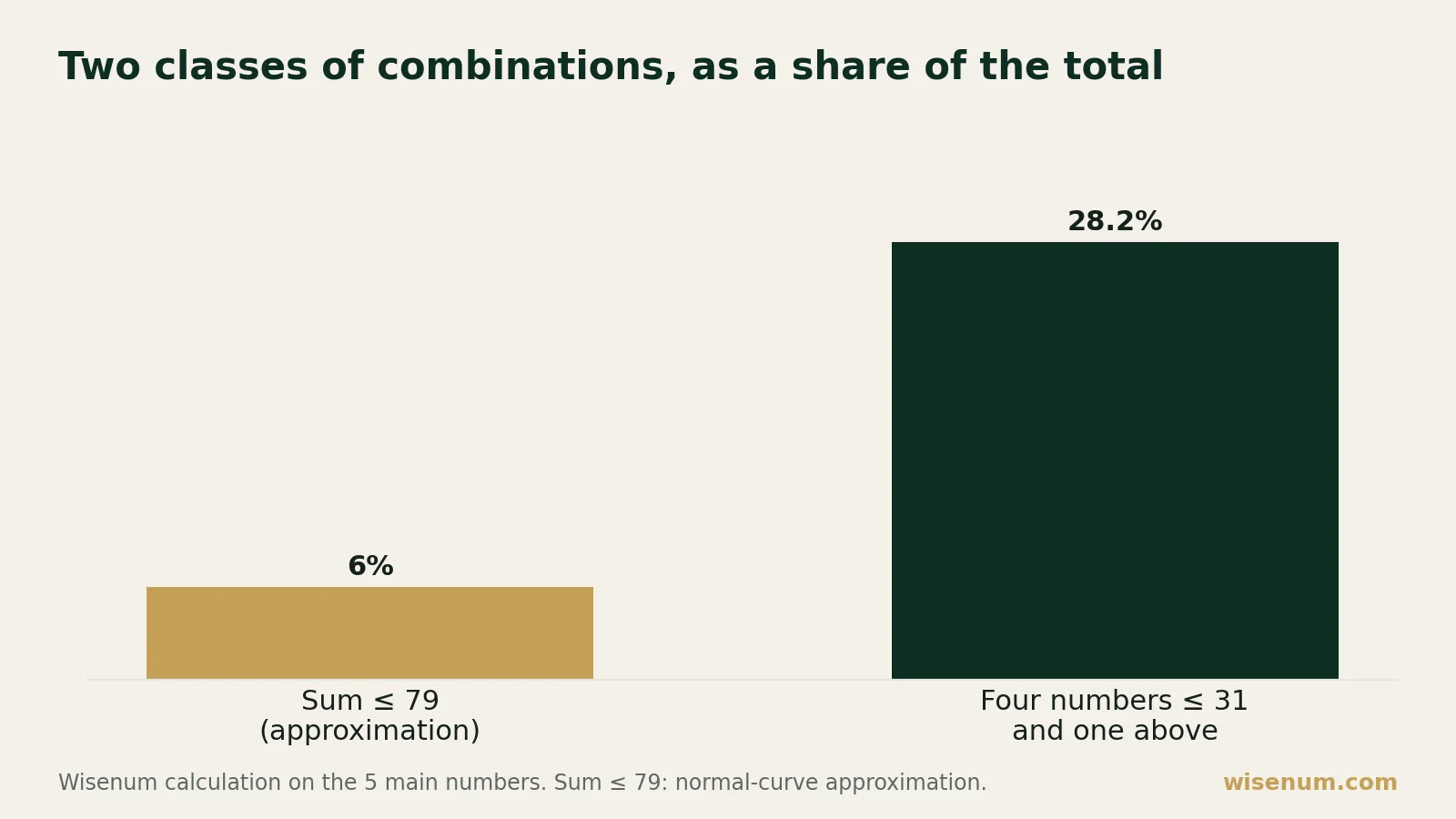
On a bell curve, about 6% of cases lie 1.56 standard deviations or more below the average. A draw with a sum this low (or lower) therefore happens roughly once in 17 draws (1 ÷ 0.06 ≈ 17). This is an approximation, not an exact count. It is enough to show that it is uncommon, not extraordinary.
The Euro numbers are not part of the sum: the proportion is the same across all 139,838,160 full lines.
Be careful with "rarity scores" published elsewhere. BeatLottery, for example, gives this draw 88/100; a score like that depends on the method, on the draw history used and on what is being compared. Our calculation covers the set of all possible combinations, with no draw history.
Popularity and sharing: the real risk
A low sum changes nothing about the probability of winning. What it can reveal, however, is something else: how players choose their numbers.
The line 04-06-07-17-45 looks like a "dates" line:
- four of the five numbers are 31 or below (04, 06, 07, 17), which matches the days of a month;
- three are 7 or below;
- 06-07 is a consecutive pair.
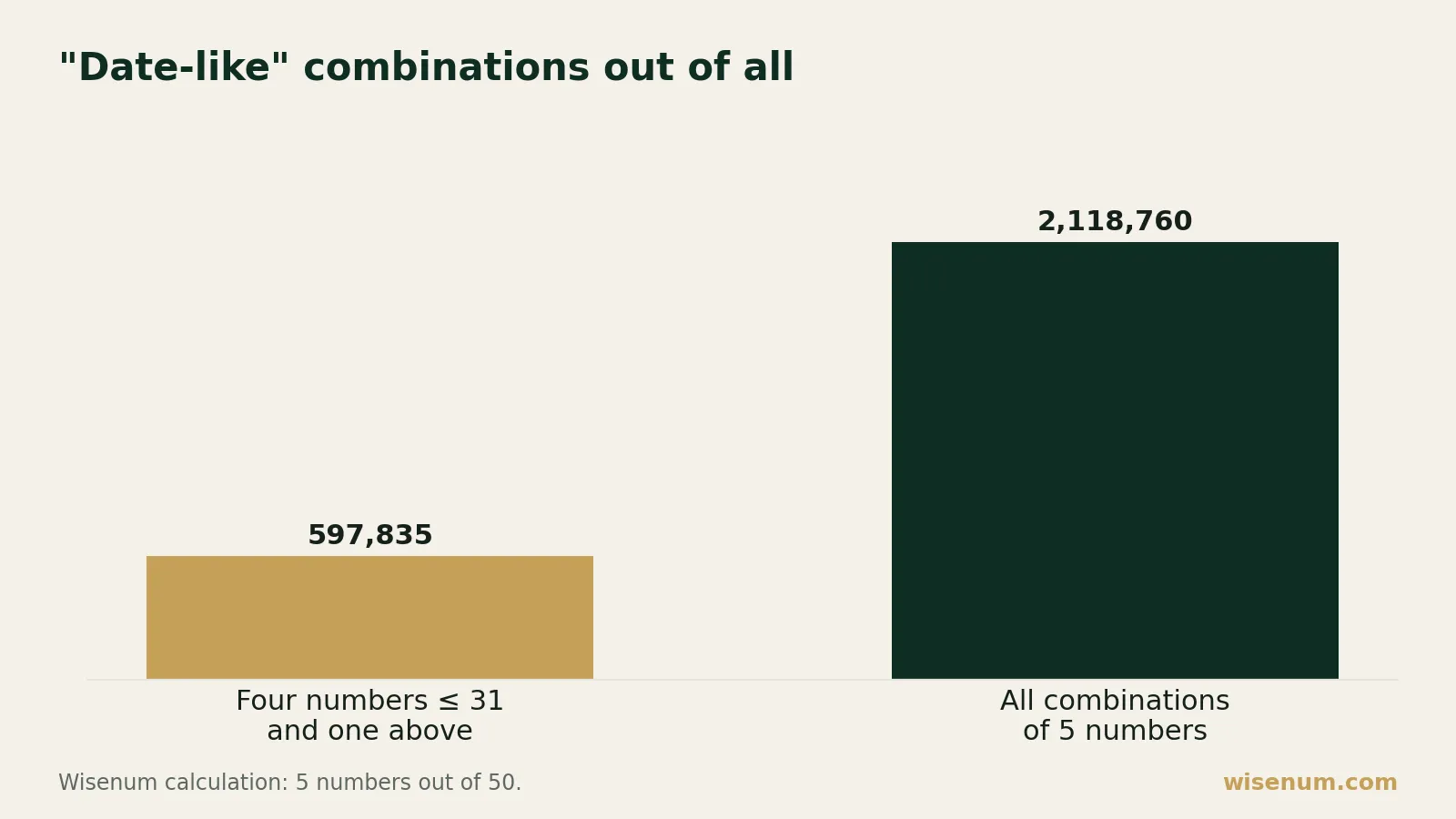
Mathematically, this profile is nothing exceptional. Counting the lines with exactly four numbers at 31 or below and just one above: C(31, 4) × C(19, 1) = 31,465 × 19 = 597,835 combinations out of 2,118,760, or 28.2%. But many players pick their numbers from dates that matter to them, as we explain in our analysis of "birthday" lines.
The consequence concerns sharing, never the draw. If a very popular line wins, the jackpot is split between more winners. Popularity does not change the probability of being drawn, but it does change what you would have to share.
For this specific line, we have no popularity measurement to quote here: the aggregated data we have for this article contains no line-by-line analysis. Wisenum's "Analyze a line" tool is made for exactly that: estimating how many players may have picked a line close to yours.
The timing is right. There was no winner in the 5+2 tier on October 2: the jackpot of €110,347,206 rolled over, and BeatLottery gives an estimate of about €120M for the October 6, 2026 draw. This is an operator estimate, which may differ from the amount announced on the day of the draw.
Draws are independent
One last point, and an essential one. The October 2 draw has no effect on the October 6 draw. The balls have no memory: a low sum does not make small numbers "used up", nor big numbers "owed". On October 6, the probability of each combination will again be 1 in 139,838,160, and the expected sum will remain centered on 127.5.
The takeaway
- The draw 04-06-07-17-45 / 07-12 had the same probability as any other combination: 1 in 139,838,160.
- What is less common is the "very low sum" class: about 6% of draws (normal-curve approximation), or roughly 1 draw in 17.
- A low sum says nothing about the next draw: draws are independent.
- The popularity of a line does not affect the probability of being drawn. It affects how many people the prize would be shared with.
Playing the next draw? See whether your line looks like the most common picks: Analyze a line.
Play for fun, and only spend what you can afford to lose. Responsible gambling support: in the US, call 1-800-GAMBLER (ncpgambling.org); in the UK, visit BeGambleAware.
Frequently asked questions
Did the October 2, 2026 draw 04-06-07-17-45 really have different odds from other draws?
No. Every combination of 5 numbers out of 50 and 2 Euro numbers out of 12 has exactly the same probability: 1 in 139,838,160. The October 2 draw was neither more nor less likely to be drawn than any other line.
Why is this draw called rare?
What is uncommon is the "low sum" class. A sum of 79 sits about 1.6 standard deviations below the average (127.5), which happens in about 6% of cases (normal-curve approximation), or roughly once in 17. That is uncommon, but far from extraordinary.
If my line looks like the October 2 draw, is there a risk?
The probability of being drawn does not change. However, a line made of small numbers often looks like the "dates" lines that many players choose. If a very popular line wins, the jackpot has to be split between more people. That is the real risk: sharing, not probability.
Does the low sum on October 2 change the October 6 draw?
Not at all. Draws are independent: the balls have no memory. A low sum does not make small numbers "used up", nor big numbers "owed". On October 6, the probability remains 1 in 139,838,160 and the expected sum will remain centered on 127.5.
How can I check whether my line is popular?
Wisenum's "Analyze a line" tool estimates how many players may have picked a line close to yours. It helps you understand the risk of sharing, especially before playing a big jackpot.
Every valid combination has the same probability of being drawn. Wisenum does not predict winning numbers.
Sources
- BeatLottery – EuroJackpot Results for 2 October 2026
- Luck.fyi – EuroJackpot Odds & Prize Statistics (C(50,5) × C(12,2) confirmation)
- Lotto-Predictions.com – All 12 Prize Tiers & Probability Breakdown
- LotteryAnalyser.eu – EuroJackpot Statistics (sum range & average)
- Pewniaki.pl – Draw Sum EuroJackpot Statistics (theoretical mean 127.5, percentile data)
- Saliu.com – Euromillions Sums Chart (5/50 + 2/12 enumeration of all combinations)
- EuroJackpot.org – Official Statistics & Game Information
- EuroLottoPredictor.eu – Smart Sums (Bell Curve Distribution) for EuroJackpot